
Work
The call-centre giants now sell the bots
TP, the outsourcer once called Teleperformance, cut its 2026 outlook on 5 November as automation and offshoring shrank its content-moderation work, and its shares fell 15.3% the next day. Malaysia’s 749 global business services companies are estimated to earn RM28.14 billion in 2025. TalentCorp rates 32% of the sector’s workers, on its own count, as highly impacted by AI and digital change.
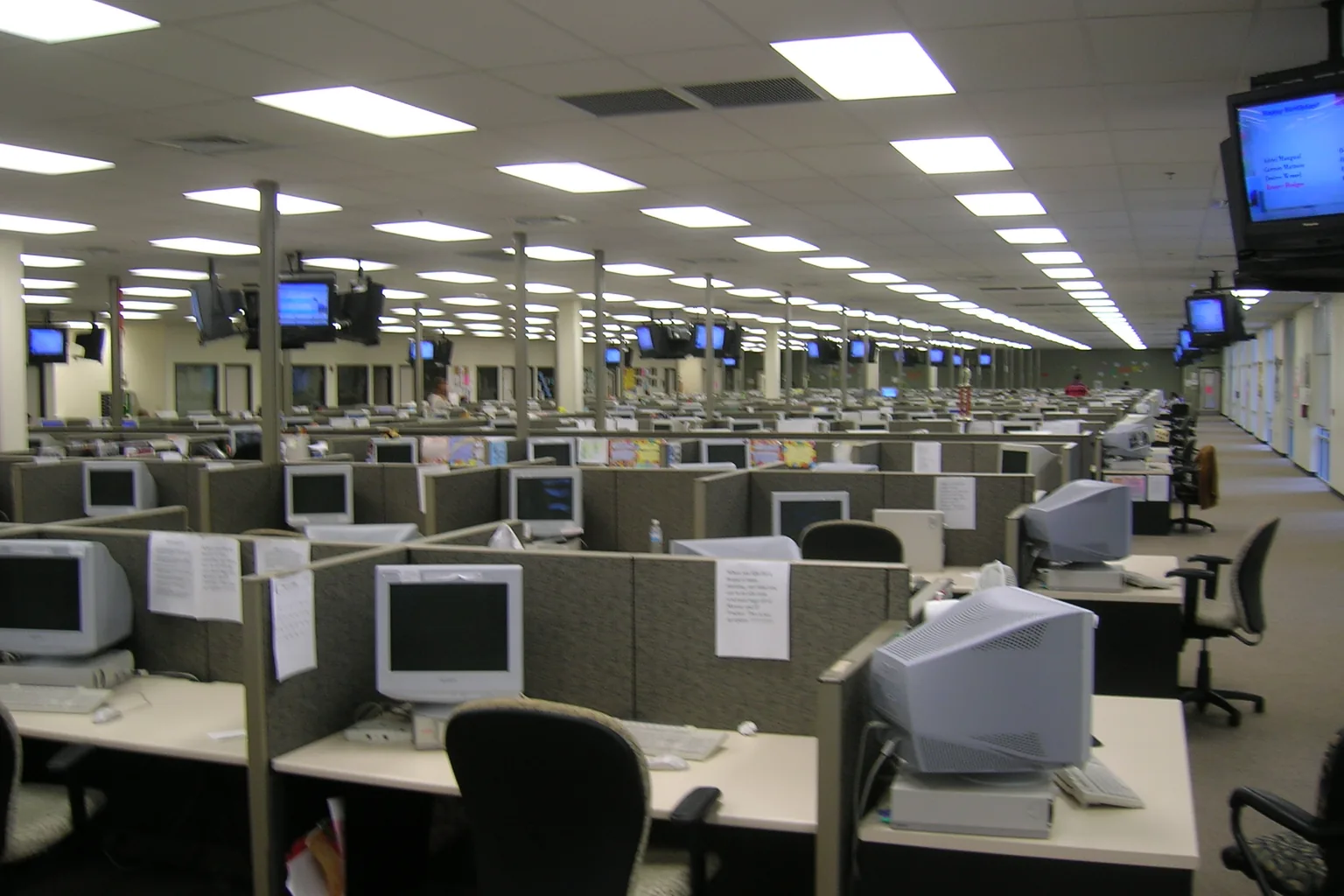
On 5 November 2026, TP, the Paris-listed outsourcer once called Teleperformance, cut its revenue forecast for the year. It now expected a like-for-like fall of 1.5% to 2.5%, against an earlier forecast of flat to 2% growth.12 Its Trust and Safety line, which moderates online content for clients, was declining on “accelerated automation and the ramp-up of offshore delivery”.1 The next day TP’s shares closed at €68.44, down from €80.80, a fall of 15.3% by our arithmetic.3
Like-for-like figures strip out currency moves and acquisitions. TP has a stake in how this plays out here. It runs contact centres in Kuala Lumpur and Penang, and in October 2025 said a Johor Bahru centre was coming. Its Malaysian staff work in English, Mandarin, Bahasa Malaysia, Hindi and other languages, the company says.4 The same results showed the other side of its business: about 1,400 AI projects at the end of September, more than double a year earlier.1 The outsourcers that built call-centre floors around the world now grow by selling AI, while automation shrinks some of their oldest work.
Malaysia’s global business services (GBS) industry sits in that path. GBS centres run finance, HR, IT and customer work for multinational companies, often in several languages. Our AI jobs article covers what automation means for graduates’ first jobs, and our outcome-pricing article covers how outsourcers are starting to be paid by results. This one looks at the industry itself: its size, centres and pay, what AI agents do there, and where they have failed. One number is missing throughout. No source we found counts the people who work in Malaysia’s contact centres.
The short version
- TP cut its 2026 outlook to a like-for-like revenue fall of 1.5% to 2.5% on 5 November 2026, and its shares fell 15.3% the next day. Its content-moderation line is shrinking under automation.
- Malaysia had 749 GBS companies in mid-2025 and an estimated RM28.14 billion of revenue for 2025. Workforce estimates run from about 120,000 to about 276,000, depending on who counts. Nobody publishes a contact-centre headcount.
- TalentCorp rates 32% of GBS employees, 89,046 people on its own base of about 276,000, as highly impacted by AI, digital and green-economy change within three to five years. No other sector it studied scored higher.
- Concentrix, which lists Malaysia among its main workforce countries, says cost cuts affected about 30,000 employees in the nine months to August 2026. Its peer group of call-centre shares lost about 74% of its value in five years.
- Only 20% of 321 service leaders surveyed by Gartner in October 2025 had cut agent staff because of AI. In a 2024 Gartner survey, 60% of customers feared AI would make it harder to reach a person.
The outsourcers feel the squeeze
TP’s third quarter was not a collapse. Revenue was €2,532 million, about RM11.4 billion, down 1.2% like-for-like. Without Trust and Safety, it grew 2.0%.1 TP expects this year’s restructuring costs at the high end of its €120–140 million range, or about RM540–630 million. It expects the programme to save €150–170 million a year, about RM675–765 million.1 Chief executive Jorge Amar said “Trust and Safety remained under pressure”. He added: “We are confident in our ability to maintain our leading position as our industry transforms.”1
The AI side is growing fast. More than 300 of TP’s 1,400 AI projects went into production in the quarter, and more than 35% of its clients use its TP.ai tools, the company says.1 In July it had described content moderation as being in “a sharp decline due to accelerated automation”.2 Much moderation work means sorting posts into allowed and not allowed, a task software classifiers can learn.
Concentrix, a US-listed rival with about 455,000 staff, names Malaysia among the 11 countries where its workforce is concentrated.5 On 29 September 2026 it reported a third-quarter net loss of US$988.1 million on revenue down 1.2%. The loss included a US$1.05 billion (about RM4.3 billion) goodwill write-down.6 Concentrix said this resulted “primarily” from “the trading range for the Company’s stock price and market capitalization”. In plain terms, the stock market valued the company at less than its accounts did.6 Its quarterly filing shows US$91.65 million (about RM375 million) of severance costs over nine months. “These actions affected approximately 30,000 employees,” it said, about 6.6% of the 455,000 staff it had in November 2025, by our arithmetic.7 Chief executive Chris Caldwell said half of revenue now came from business won and deployed in the three years since AI arrived.6
While we are aggressively disrupting our own traditional business, the underlying new business is stronger and healthier as evidenced by our margin expansion, strong free cash flow and growth of our new services.
Investors have feared this moment for almost three years. On 28 February 2024 Teleperformance shares fell as much as 29.3%, after Klarna said its AI assistant was doing “the equivalent work of 700 full-time agents”.8 A week later its founder and chief executive, Daniel Julien, pushed back on CNBC. “The day the customer is going to be a robot, maybe AI will replace the humans,” he said. TP saw AI “as enhancing the job that our human employees do, but absolutely not replacing them”.9 More than two and a half years on, TP’s revenue is edging down, not collapsing, while the work inside it changes.1
Shareholders kept score anyway. Concentrix’s annual report tracks US$100 invested in December 2020 in its own shares and in six call-centre rivals. It compares both with the S&P MidCap 400, an index of mid-sized US companies. By November 2025 the rivals’ US$100 was worth US$25.83.5
Concentrix’s peer group is Majorel, TaskUs, TDCX, TP (Teleperformance), TELUS International and TTEC, each counted while listed. TDCX went private in June 2024 and TELUS International in October 2025. The 74% fall is our arithmetic. TP’s shares fell a further 15.3% after its 5 November 2026 outlook cut.
Source: Concentrix, Form 10-K for the year to 30 November 2025 (28 January 2026); Yahoo Finance closing prices (6 November 2026).
Show the numbers
| Date | S&P MidCap 400 | Concentrix | Call-centre peer group |
|---|---|---|---|
| Dec 2020 | US$100.00 | US$100.00 | US$100.00 |
| Nov 2021 | US$123.43 | US$158.10 | US$121.30 |
| Nov 2022 | US$117.47 | US$116.55 | US$72.41 |
| Nov 2023 | US$116.82 | US$89.51 | US$35.76 |
| Nov 2024 | US$153.39 | US$42.81 | US$26.18 |
| Nov 2025 | US$164.58 | US$36.89 | US$25.83 |
What an AI agent does on a service floor
A call-centre bot used to be a phone menu or a chat window with scripted answers. The newer kind runs on a large language model, which reads a request in ordinary words and writes a reply. IBM describes its HR helpdesk agent, AskHR, in these terms. Its models “classify the employee prompt, route it to the relevant HR domain”, such as benefits or payroll, “and then trigger a task or provide an AI-generated response”.10
Outsourcers use the technology in three places. Self-service agents answer customers directly. Assistants sit beside a human agent and suggest replies, an approach whose evidence our AI jobs article reviews. Back-office agents work through claims, invoices and HR requests. TalentCorp says AI has reduced rules-driven work, “particularly in tasks such as back-office claims processing and managing customer feedback”.11
The big outsourcers build their own tools. TP’s Malaysian operation lists Digital Floorwalker, a generative AI assistant for agents, and StoryfAI, a multilingual translation engine.4 Concentrix says its iX Hello assistant can translate text in more than 90 languages and transcribe voice.5 Those are the skills Malaysian centres sell. Software companies are automating their own support too. Salesforce announced it was replacing about 1,000 jobs, “primarily in customer support and operational roles”, with AI agents, an ISEAS paper notes.12
- 1CustomerA request arrivesA customer or employee writes or calls, by chat, email or voice, often in their own language.
- 2AI agentThe model reads and routes itA language model classifies the request and finds the matching policy or account record. IBM’s AskHR routes questions to areas such as benefits and payroll.
- 3AI agentIt answers or actsRoutine requests get a reply or a finished task, such as a letter or a leave request. IBM counts 94% of common questions as contained.
- 4Human agentApprovalA person takes overComplex or uncertain cases pass to a human. Nearly 90% of customers say that option must stay, Gartner found in 2026.
- 5CompanyLogs train the next versionConversations feed retraining. Malaysia’s draft AI data framework asks firms to check, and where needed re-test, a chatbot retrained on customer data before using it.
Containment means a question did not reach a person. It does not show that the answer was right.
Source: IBM, AskHR case study (2025); CX Dive (25 August 2026); JPDP Public Consultation Paper No. 1/2026 (October 2026).
Show the numbers
| Step | Who | What | Detail |
|---|---|---|---|
| 1 | Customer | A request arrives | A customer or employee writes or calls, by chat, email or voice, often in their own language. |
| 2 | AI agent | The model reads and routes it | A language model classifies the request and finds the matching policy or account record. IBM’s AskHR routes questions to areas such as benefits and payroll. |
| 3 | AI agent | It answers or acts | Routine requests get a reply or a finished task, such as a letter or a leave request. IBM counts 94% of common questions as contained. |
| 4 | Human agent | A person takes over (approval) | Complex or uncertain cases pass to a human. Nearly 90% of customers say that option must stay, Gartner found in 2026. |
| 5 | Company | Logs train the next version | Conversations feed retraining. Malaysia’s draft AI data framework asks firms to check, and where needed re-test, a chatbot retrained on customer data before using it. |
Vendors usually report success as containment: the share of questions that never reached a person. IBM says AskHR achieved “a 94% containment rate of common questions”.10 Containment does not show that an answer was right, or that the customer had not given up. How vendors define a resolved query is a theme of our outcome-pricing article.
Even where automation is furthest along, the job shrinks slowly. The US had about 2.7 million customer service representatives in 2025. Federal statisticians project a 5% fall by 2035 because “their tasks continue to be automated”. They still expect about 289,500 openings a year, which in a shrinking occupation means replacing people who leave.13
Someone also has to teach the machines. TaskUs, a US-listed outsourcer with 38,100 of its 65,500 staff in the Philippines and operations in Malaysia, now sells “AI services”.14 Its filing defines these as large language model support, data labelling, annotation and transcription “performed for the purpose of training and tuning machine learning algorithms”.14 The line made 18% of 2025 revenue and grew 27.7% in the third quarter of 2026.1415
AI services covers data labelling, annotation, transcription and support for large language models, done to train and tune AI. The line grew 27.7% year on year in the third quarter of 2026.
Source: TaskUs, Form 10-K for 2025 (5 March 2026); TaskUs third-quarter 2026 results (4 November 2026).
Show the numbers
| Item | Digital customer experience | Trust and safety | AI services (training AI) |
|---|---|---|---|
| 2024 (US$995.0m) | 61% | 25% | 14% |
| 2025 (US$1,183.5m) | 56% | 26% | 18% |
The hub Malaysia built
Malaysia has spent two decades selling itself as a place to run other companies’ back offices. The industry’s mid-term report, published in October 2025 with MDEC data, counts 749 GBS companies in mid-2025, 66.8% more than in 2021.16 It estimates revenue at RM28.14 billion for 2025, about US$6.88 billion, up from an estimated RM22.09 billion in 2021, or about 6.2% a year by our arithmetic.16 The report labels every year in that series an estimate and credits it to the 2022 strategy itself, so the yearly figures may be projections rather than measured revenue.16
The report labels every year an estimate and sources the series to the GBS Malaysia Strategy 2022–2027. The 6.2% average annual growth is our arithmetic. RM28.14 billion is about US$6.88 billion at the 17 November 2026 rate.
Source: GBS Malaysia (PIKOM), GBS Malaysia Strategy 2022–2027 Mid-Term Report, page 16 (30 October 2025).
Show the numbers
| Year | RM billion |
|---|---|
| 2021 | 22.09 |
| 2022 | 23.44 |
| 2023 | 24.91 |
| 2024 | 26.46 |
| 2025 est. | 28.14 |
The work is less about telephones than the label suggests. MDEC classes 57% of the sector as IT services, such as programming and network support. Business process services, covering HR, finance and customer-facing work, make up 33%. Knowledge process services, complex work that needs professional expertise, make up 10%.16 The report does not say whether these are shares of companies, jobs or revenue.
The report does not say whether the split is by companies, jobs or revenue. Contact-centre work falls in the business process share.
Source: GBS Malaysia (PIKOM), Mid-Term Report, page 19, citing MDEC (30 October 2025).
Show the numbers
| Share | What |
|---|---|
| 57% | IT services: programming, technical support, desktop, server, network and security work |
| 33% | Business process services: back-office HR and finance, plus customer-facing work |
| 10% | Knowledge process services: complex work that needs professional expertise |
Growth is concentrated, and increasingly home-grown. Selangor and Kuala Lumpur took 87% of new GBS companies between 2021 and mid-2025, though new firms opened in 12 locations, including Sabah and Sarawak. Malaysian-origin firms made up 94 of the 167 new GBS companies in 2024, against 23 of 44 in 2022, the report’s chart shows.16 Foreign arrivals cooled. The first half of 2025 showed “a dramatic slowdown in new companies from the Americas and Europe compared to 2024’s peak”, the report says.16 Many are big names. Knight Frank counted 607 GBS companies in 2024 and said about 30% were on the Forbes Global 2000 or Fortune 500 lists. Citing Kearney, it put Malaysia’s share of the Asia-Pacific offshoring market at about 8%.17
Approvals continue. MDEC said its RM87.4 billion of approved digital investment in 2025 should create more than 31,000 jobs, 9,000 of them in GBS, or about 29% by our arithmetic.18 In the second quarter of 2026, AI, data-centre and GBS firms made up nearly 70% of 119 companies newly approved for Malaysia Digital status. Yet MDEC’s Muhammad Hafiz Wan Rosli said only 38% of Malaysian enterprises had adopted AI.19
Nobody counts the call-centre workers
How many people work in Malaysia’s GBS industry depends on who is counting. Bernama put the sector at “120,000 jobs” in August 2025, in a story about AI, without naming a source.20 Digital News Asia wrote in September 2026 that the workforce was “more than 150,000 today”, against around 20,000 in the early 2000s. It gave no source either.21
TalentCorp, the government’s talent agency, used a larger base for its 2024 impact study: about 276,000 GBS employees. It counted only “skilled and semi-skilled” staff “in the core businesses of the sectors”.11 Only TalentCorp says what it counted. The gaps are too large to be growth. GBS companies created 36,626 jobs between 2021 and mid-2025, the industry report says.16
Contact centres are a blind spot inside that blind spot. No source we opened gives a headcount for them. At the National Contact Centre Conference in May 2026, the president of the Contact Centre Association of Malaysia said the industry was evolving rather than shrinking, MDEC reported. No figures were given.22 MDEC itself cites a Milken Institute ranking that puts Malaysia first in Southeast Asia for contact-centre operations. We did not see the underlying index.22 Without a count, nobody can tell whether AI is cutting Malaysian service jobs, or whether work is arriving from elsewhere.
Where the desks are
Most GBS work sits in the Klang Valley. Knight Frank wrote in 2024 that GBS companies first clustered in Cyberjaya. Bangsar South, Taman Tun Dr Ismail, Bandar Utama, Mutiara Damansara and Bandar Sunway are now established nodes too. Office rents there ran US$1.00 to US$1.50 per square foot a month.17 It named the Tun Razak Exchange as the hub for finance work and Cyberjaya for IT. Penang’s prime office rents were about 25% below the capital’s.17
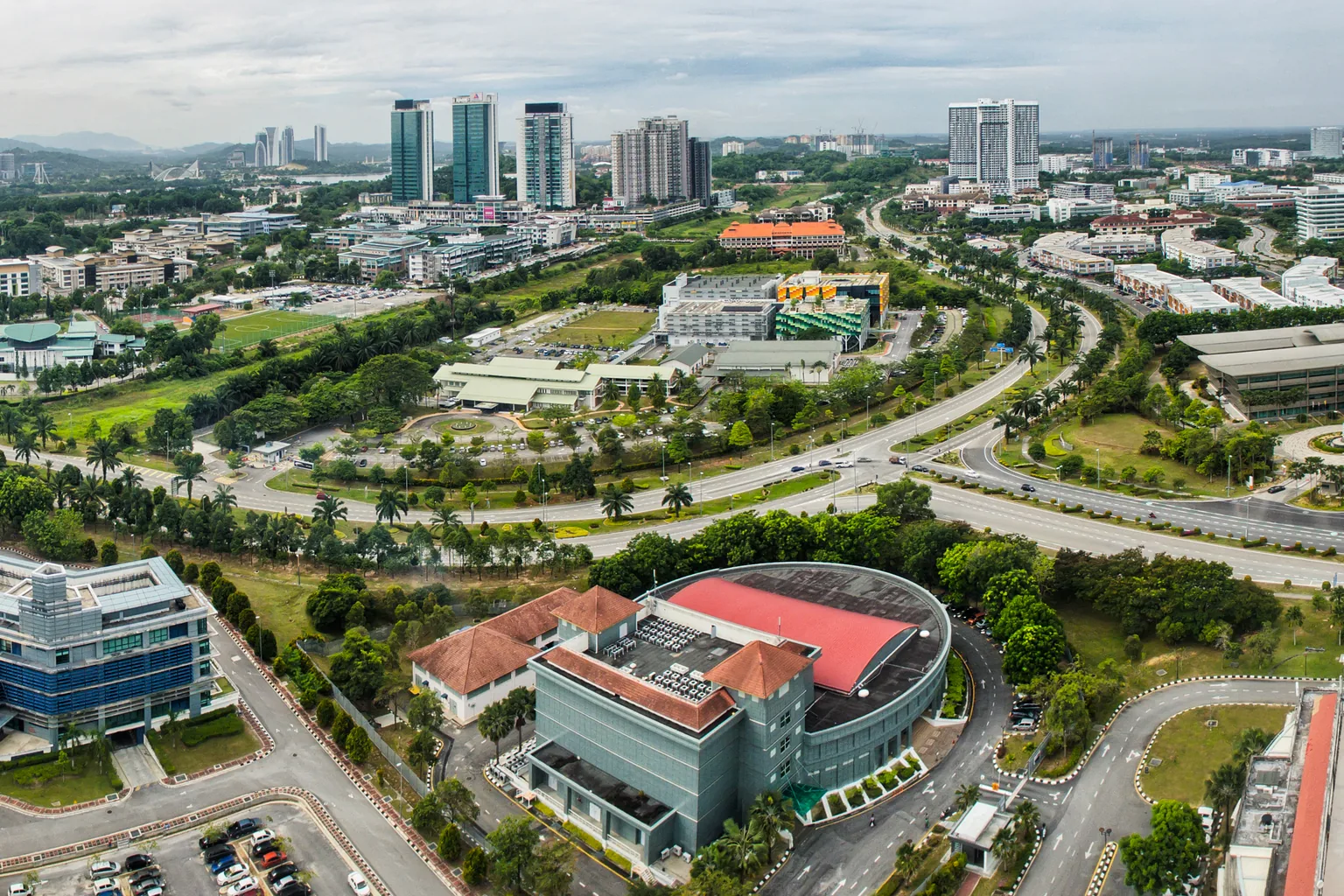
Multinationals run many of the biggest centres for themselves. Standard Chartered set up its Kuala Lumpur GBS unit in 2001. It employs more than 4,400 people, 85% of them Malaysian, and supports the bank in more than 50 markets. It is the bank’s largest GBS footprint outside India.23 AMD employed more than 800 people at two GBS sites, in Penang and Cyberjaya, in 2023. Its expansion was to take about 70% of the RM200 million “GBS by the Sea” building in Bayan Lepas.24
Outsourcers serve many clients from one floor. Concentrix and TaskUs both list Malaysian operations.514 TP says its Malaysian staff serve more than 15 markets around the clock.4 Scicom (MSC) Bhd is a Bursa-listed contact-centre and outsourcing operator whose turn towards government technology appears in the cases below.25
Languages are the edge, and AI is learning them
The industry’s report says “Malaysia’s bilingual, culturally diverse workforce continues to be a cornerstone strength”.16 Randstad, a recruiter, writes that the country’s edge “increasingly lies in its quality of talent”.26 Machines now do part of that work. Besides Concentrix’s 90-language translator, TP resells software from Sanas, a US start-up, that alters agents’ accents in real time. TP invested US$13 million, about RM53 million, in Sanas.27
In early 2025 Bloomberg quoted TP deputy chief executive Thomas Mackenbrock as saying the software could “neutralize the accent of the Indian speaker with zero latency”. His reasoning: “When you have an Indian agent on the line, sometimes it’s hard to hear, to understand.”27 Sanas says its goal is “reducing accent-based discrimination”.27 Either way, fluency in a client’s language, the skill Malaysia markets hardest, is becoming something software also sells.
Who TalentCorp says is exposed
The most detailed exposure estimate comes from TalentCorp. Its study, launched on 18 November 2024, covered 10 sectors and about 3.5 million employees. It expects about 620,000 of them, or 18%, to be highly impacted within three to five years by AI, digitalisation and the green economy.28
GBS came out worst. On TalentCorp’s own base of about 276,000, 89,046 employees, or 32%, are highly impacted. The study blames “the extensive use of automation through AI and Digital for routine or transactional tasks”.11 GBS also had the most highly impacted roles, 18 of the 84 identified across all sectors. It is also one of the three sectors, with aerospace and ICT, that reported the highest rates of AI adoption.11
Three cautions apply. The rating mixes AI with digital tools and green-economy change. It covers core skilled and semi-skilled staff, so it is no census. And the GBS high, medium and low groups add up to 251,755, about 91% of the 276,000 base, by our arithmetic. The study does not explain the rest.11 For customer service representatives, it suggests moves into customer relationship management, dispute resolution, or sales operations in retail.11
Wider estimates point the same way. An ISEAS paper in June 2026 noted that services employ about 10 million Malaysians, 65% of all workers. Under its stated assumptions, about 320,000 jobs could be at risk from generative AI alone and about 680,000 with AI agents. The author stresses that these “are not forecasts”.12 In October 2024 the human resources ministry reported about 300,000 jobs lost to automation and AI since 2020, but with no yearly breakdown.12
Globally, the International Labour Organization puts one in four workers in jobs with some generative AI exposure. “Clerical occupations continue to have the highest exposure levels,” it says. Women are more exposed than men: 4.7% of women’s jobs fall in the highest category, against 2.4% of men’s. Exposure also rises with income, to 34% of jobs in high-income countries against 11% in low-income ones.29
Pay, languages and incentives
Randstad’s 2026 salary guide shows how steeply shared-services pay rises with seniority. An analyst with one to three years’ experience earns RM3,000 to RM5,500 a month in basic pay. A manager earns RM9,000 to RM15,000, and a shared-services centre director RM30,000 or more.26 AGOS Asia told Bernama that monthly salaries above RM10,000 are common for specialised skills such as data engineering.20 For comparison, the median US customer service representative earned US$21.53 an hour in May 2025, about RM88, or US$44,770 a year, about RM183,000.13
Basic pay only, excluding bonuses. Randstad lists the top of the range for senior manager, tower lead and director as more than RM20,000, RM27,000 and RM50,000. The director row comes from Randstad’s management table.
Source: Randstad Malaysia, 2026 Market Outlook and Salary Guide, page 42 (December 2025).
Show the numbers
| Item | Bottom of range | Top of range |
|---|---|---|
| Analyst (1–3 years) | RM3,000 | RM5,500 |
| Senior analyst (3–5 years) | RM4,500 | RM8,000 |
| Specialist or team lead (5–10) | RM5,000 | RM9,000 |
| Manager (8–13 years) | RM9,000 | RM15,000 |
| Senior manager (13–18 years) | RM15,000 | RM20,000 |
| Tower lead (over 18 years) | RM18,000 | RM27,000 |
| Centre director (over 15 years) | RM30,000 | RM50,000 |
Languages add a premium on top. Japanese or Korean can add up to RM3,000 a month, and so can a European language such as French or German. Thai and Vietnamese add up to RM2,000.26
| Language | Low (RM) | Middle (RM) | High (RM) |
|---|---|---|---|
| Japanese | 500–1,000 | 1,000–2,000 | 2,000–3,000 |
| Korean | 500–1,000 | 1,000–2,000 | 2,000–3,000 |
| Thai | 500–800 | 800–1,500 | 1,500–2,000 |
| Vietnamese | 500–800 | 800–1,500 | 1,500–2,000 |
| European languages (French, Spanish, Russian, German and others) | 1,000–1,500 | 1,500–2,500 | 2,500–3,000 |
Source: Randstad Malaysia, 2026 Market Outlook and Salary Guide, page 42. Paid on top of basic monthly salary.26
The guide is blunt about AI. “The traditional ‘processor’ roles that once anchored shared services are being automated through business process automation or offshored to lower-cost markets,” it says.26 Demand is moving to controllers, financial planning and analysis, record-to-report specialists and transformation leads. Turnover is high “due to the abundance of job opportunities”.26
Incentives aim at the top
Tax incentives reward senior jobs. The Global Services Hub (GS-Hub) incentive, which replaced the Principal Hub scheme, offers a corporate tax rate of 5% or 10%. MIDA accepts applications until 31 December 2027.30 One condition is that at least half of “high value jobs”, paying a basic RM10,000 a month or more, “must be filled by Malaysian”. Up to three foreign senior executives earning at least RM35,000 a month can pay a flat 15% income tax.30 Finance, accounting, HR and training count as qualifying shared services, alongside the regional management a hub must also do.30
Support for entry-level hiring is smaller. The MD Workforce Place & Train programme pays employers up to RM6,000 in salary incentives over three months, plus up to RM2,000 for training, per approved hire. Budget 2026 adds a 50% extra tax deduction for SMEs on certified AI and cybersecurity training.16
The Philippines and India feel it first
Malaysia is small next to its two big rivals. The Philippine IT and business process management (IT-BPM) industry earned US$40.3 billion in 2025, about RM164.8 billion, with 1.9 million full-time workers. Its association, IBPAP, expects 1.96 million workers this year and 1.99 million in 2027. That is below its original 2027 baseline of 2 million to 2.3 million.31 Its deeper cut to 2028 targets is told in our AI jobs article.32
For years, our industry has measured success by how many people we could employ. The next chapter will increasingly be defined by the value every Digital Filipino Worker (DFW) creates.
Madrid said the evolution he wanted was “higher revenue per employee”.32 When he listed the countries now joining the race, he named South Africa, Egypt, Poland, Colombia, Costa Rica and Vietnam. Malaysia was not among them.31 TP, for its part, said in July 2026 that India and Egypt were growing on demand for offshore work.2 TaskUs shows how concentrated the work is: 54% of its 2025 revenue came from work done in the Philippines and 13% from India.14
India’s tech industry, the largest of the three, expects US$315 billion of revenue in its 2026 financial year, up 6.1%, with US$59 billion from business process management. Headcount still rose about 2.3%, Nasscom says.33 Its biggest IT company moved the other way. In July 2025 Tata Consultancy Services said it would cut about 12,000 jobs, around 2% of its 613,000 staff, mainly in middle and senior roles.34
| Hub | What is counted | Revenue | Workers |
|---|---|---|---|
| India | Business process management, 2026 financial year estimate | US$59bn (about RM241bn) | Not given for BPM alone |
| Philippines | IT and business process management, 2025 | US$40.3bn (about RM165bn) | 1.9 million |
| Malaysia | Global business services, including IT and knowledge work, 2025 estimate | RM28.14bn (about US$6.9bn) | About 120,000 to 276,000 |
Source: Nasscom (24 February 2026); Philstar (15 July 2026); GBS Malaysia Mid-Term Report (30 October 2025); Bernama (21 August 2025); TalentCorp (2024).1116203133
On revenue, India’s BPM industry is more than eight times Malaysia’s GBS sector and the Philippines nearly six times, by our arithmetic. The definitions differ, so these are checks of scale, not rankings.
When the bot speaks for the company
Customers have been wary from the start. In a 2024 Gartner survey of almost 6,000 customers, 64% said they would prefer companies not to use AI in customer service. The most common fear, cited by 60%, was that AI would make it harder to reach a person.35 In a 2026 Gartner survey of more than 3,500 customers, nearly 90% said firms using generative AI must keep a human available. Gartner’s Eric Keller said that “if you make it easier to switch to a person, it helps with longer-term adoption”.36
Malaysians have met the problem closer to home. AirAsia’s first chatbot, AVA, handled tens of millions of queries before its chief executive retired it in 2023.37
AVA was the most hated AI chatbot in Asean.
Managers are learning the same lesson. In a Gartner poll of 163 service leaders, published in June 2025, 95% planned to keep human agents alongside AI. Half the organisations said plans to cut their service workforce significantly would be abandoned by 2027. “While AI offers significant potential to transform customer service, it is not a panacea,” said Gartner analyst Kathy Ross.38 By October 2025, only 20% of 321 service leaders had reduced agent staffing because of AI. Yet US employers cited AI in 54,836 announced job cuts in 2025, the outplacement firm Challenger, Gray & Christmas counted.39
Two forecasts expect some cuts to be undone. Gartner predicts that by 2027 half the companies that blamed service job cuts on AI will rehire for similar work. Forrester expects “half of AI-attributed layoffs to be quietly reversed, with jobs returning offshore or at lower wages”.39 It also found that 55% of employers regret laying off workers because of AI.40 The rehiring figures are predictions, not counts. If they hold, some returning work could land in hubs like Malaysia, but no data yet shows where it goes.
The law treats the bot as the company
A tribunal has already ruled that a company owns what its bot says. In February 2024 a Canadian tribunal ordered Air Canada to pay a customer its chatbot had misled, a case set out below and in our AI pilots article.41
In the US, a Senate bill introduced in July 2025 would make agents disclose their physical location at the start of each contact. Companies would also have to say when “a nonhuman, artificial intelligence or machine is being used for customer service”.42 Customers could ask to be transferred at once to a human agent located in the US, if possible by saying the word “agent”. Employers moving call-centre work abroad would have to give 120 days’ notice, on pain of up to US$10,000 (about RM40,900) a day.42 “People want to have the option of speaking to a human or AI,” said its sponsor, Senator Ruben Gallego.43 If it became law, agents in Malaysian centres serving US customers would in most cases have to say where they are.
Malaysia is writing its own rules. In October 2026 the Personal Data Protection Department (JPDP) consulted on an AI and personal data framework. Its draft says engaging an AI provider “does not transfer or diminish the responsibilities of the data controller”.44 Cross-border AI use must comply with section 129 of the Personal Data Protection Act, with a Transfer Impact Assessment where appropriate.44 For GBS centres, whose work crosses borders every hour, that clause matters most. The industry report already flags the amended data-protection rules, including mandatory breach notification and stricter rules on cross-border transfers.16 Bank Negara’s governor said in July 2026 that more than 70% of financial service providers use at least one AI application. Responsibility, he warned, cannot be handed to an algorithm.45
What worked and what didn’t
The pattern is consistent. Bots worked where questions were narrow and a person stayed within reach. They failed where companies cut first and checked later.
Worked
IBM’s HR helpdesk keeps a human tier
IBM’s internal agent, AskHR, automates more than 80 HR tasks, such as employment letters and leave requests. AI handles routine questions, and human advisers take complex ones. IBM says AskHR contained 94% of common questions, logged more than 11.5 million employee interactions in 2024, and helped cut HR operating costs by 40% over four years.10 Chief executive Arvind Krishna said AI agents had taken over work once done by hundreds of HR staff, but told The Wall Street Journal that IBM’s total employment had gone up, SHRM reported.46
Why it worked: narrow questions answered from 7,000 policy pages, with a person behind the bot. The figures are IBM’s own.
Worked
TaskUs sells the work AI needs
TaskUs grew 2025 revenue 19%, to US$1,183.5 million or about RM4.8 billion, as its AI services line rose to 18% of the total.14 On 4 November 2026 it reported record quarterly revenue of US$314.7 million. AI services grew 27.7% and passed US$250 million over 12 months. Chief executive Bryce Maddock said the quarter’s momentum “was fueled by 28% growth in AI Services”. Headcount slipped to about 64,700, against 65,500 at the end of 2025.15
Why it worked: it sold labelling and model support to AI builders. Its own filing warns that clients’ automation “may ultimately result in the automation of some services that TaskUs currently provides”.14
Worked
Scicom folds the call centre into government tech
Shares in Scicom (MSC) Bhd opened at RM2.20 on 11 August 2026, their highest since August 2017, leaving them up 60% so far that year, The Edge reported. Revenue for the nine months to March 2026 rose 46.5% to RM222.83 million, and net profit more than doubled to RM34.62 million. Its government work includes systems for foreign students’ visa applications, with processing and contact-centre services. It also won a Telekom Malaysia contract to jointly develop AI-enabled customer engagement. Chief executive Leo Ariyanayakam linked the rally to the firm “tackling the AI game in a big way and also Gov-Tech”.25
Why it worked: it sells the system, the processing and the call centre as one contract. The firm is small, valued at about RM771 million that day.
Worked
Standard Chartered builds on a 25-year-old centre
Standard Chartered’s Kuala Lumpur GBS unit, opened in 2001, was the country’s first multi-disciplinary GBS centre of an international bank. It employs more than 4,400 people, 85% of them Malaysian, about 3,740 by our arithmetic.23 In April 2026 the bank put its first Global Fusion Centre there, joining people, technology and intelligence functions to improve real-time response.23
Why it worked: the bank keeps adding work to an established centre staffed mostly by Malaysians. Over the same years Malaysia’s GBS companies grew to 749.16
Worked
An assistant beside the agent
In a study of 5,172 customer-support agents, access to an AI assistant raised issues resolved per hour by 15% on average. Less experienced agents gained the most. Customers were “more polite and less likely to ask to speak to a manager”.47 Our AI jobs article covers the study in detail.
Why it worked: a person stayed on every conversation, and the tool made beginners faster rather than replacing them.
Unproven
Microsoft’s US$500 million saving
In July 2025 TechCrunch, citing Bloomberg, reported a claim by Judson Althoff, Microsoft’s chief commercial officer. AI, he said, had saved the company more than US$500 million, about RM2.04 billion, in its call centre in a year. The remark came about a week after Microsoft laid off more than 9,000 workers.48
Lesson: a savings figure with no method and no measure of service quality tells buyers little.
Didn’t work
AirAsia’s AVA
AirAsia’s chatbot AVA went live in January 2019 and handled more than 113 million guests, including over 43 million queries in 2020 alone. In February 2023 Capital A chief executive Tony Fernandes replaced it with a new bot, Ask Bo. “We recognize she (AVA) fell short of people’s expectations, and we want to do better,” he said. Live human agents were promised inside the chat from the following month.37
Lesson: handling volume is not the same as helping people. AirAsia’s fix was to put humans back into the chat.
Didn’t work
Air Canada’s chatbot
After Jake Moffatt’s grandmother died in November 2022, Moffatt asked Air Canada’s website chatbot about bereavement fares. It said a reduced rate could be claimed “within 90 days of the date your ticket was issued”. The airline’s own bereavement page said the policy did not apply after travel. Air Canada argued it could not be held liable for the chatbot. The tribunal called this “a remarkable submission” and in February 2024 ordered it to pay C$812.02.41
Lesson: “It makes no difference whether the information comes from a static page or a chatbot,” the tribunal wrote.41
Didn’t work
Cursor’s support bot invents a rule
In April 2025 users of Cursor, an AI coding tool, were told by its support email that a single-login limit was expected behaviour. The reply came from an AI bot, and the policy did not exist. “Hey! We have no such policy,” co-founder Michael Truell wrote on Reddit. “Unfortunately, this is an incorrect response from a front-line AI support bot.”49
Lesson: ground replies in written policy and label them. Cursor now marks AI email replies clearly as AI.49
Didn’t work
A voice bot that raised call volumes
In July 2025 Commonwealth Bank of Australia cut 45 customer-service roles as it introduced an AI voice bot. Calls rose, and the union said managers offered overtime and pulled team leaders onto the phones. In August the bank reversed the cuts and apologised for an “error”. “CBA has been caught out trying to dress up job cuts as innovation,” said Julia Angrisano, national secretary of the Finance Sector Union.50 Our AI jobs article has the full story.
Lesson: measure call volumes and resolutions before cutting staff.
| Product | Person within reach | Checked before scaling | Error owned | Verdict |
|---|---|---|---|---|
| IBM AskHRHR helpdesk, 2024 | Yestwo-tier support | Unknown | Unknown | ✓Company figures |
| Agent-assist study5,172 agents | Yeshuman on every chat | Yesstaggered rollout | Unknown | ✓15% more resolved |
| AirAsia AVA2019–2023 | Nohumans added in 2023 | Unknown | YesCEO admitted it | ✕Replaced |
| Air CanadaChatbot, 2022 | Partlyphone line | Nocontradicted policy page | Noargued not liable | ✕Lost tribunal case |
| CursorSupport bot, 2025 | Unknown | Noinvented a policy | Yesco-founder apologised | ✕Replies now labelled |
| Commonwealth BankVoice bot, 2025 | Yesstaff still on phones | Nocalls rose | Yesapologised | ✕Cuts reversed |
Our reading of the sources cited in this article. “Unknown” means we found no public evidence either way.
Source: IBM (2025); Brynjolfsson, Li and Raymond (2024); Tech Wire Asia (9 February 2023); Civil Resolution Tribunal (14 February 2024); The Register (18 April 2025); ABC News (21 August 2025).
Show the numbers
| Product | Person within reach | Checked before scaling | Error owned | Verdict |
|---|---|---|---|---|
| IBM AskHR | Yes (two-tier support) | Unknown | Unknown | Company figures |
| Agent-assist study | Yes (human on every chat) | Yes (staggered rollout) | Unknown | 15% more resolved |
| AirAsia AVA | No (humans added in 2023) | Unknown | Yes (CEO admitted it) | Replaced |
| Air Canada | Partly (phone line) | No (contradicted policy page) | No (argued not liable) | Lost tribunal case |
| Cursor | Unknown | No (invented a policy) | Yes (co-founder apologised) | Replies now labelled |
| Commonwealth Bank | Yes (staff still on phones) | No (calls rose) | Yes (apologised) | Cuts reversed |
Things you probably didn’t know
- One outsourcer outearns the whole sector. Concentrix’s revenue of US$9.83 billion in its 2025 financial year, about RM40.2 billion, was about 1.4 times Malaysia’s estimated GBS revenue for 2025, by our arithmetic.516
- Most outsourcing is no longer voice. TaskUs earned 87% of its 2025 revenue from non-voice, digital or omnichannel work.14
- Half of Concentrix is in Asia-Pacific. About 240,000 of its 455,000 staff were based in Asia-Pacific in November 2025.5
- Two rivals left the stock market. TDCX went private in June 2024 and TELUS International in October 2025.5
- A buyout failed at the ballot. On 8 October 2025 TaskUs shareholders did not approve a deal to take the company private, backed by its co-founders and an outside investor. It ended with no termination fee.51
- GBS made a third of Malaysia Digital jobs. GBS companies created 35% of all jobs created by Malaysia Digital companies since 2021, and 47.8% at the 2024 peak.16
- TP hires with AI too. Its HaireX recruiting tool raised hires per recruiter by 31%, the company says.1
- The regulator’s retraining example is a chatbot. JPDP’s October 2026 consultation used a customer-service chatbot, retrained on more customer data, as its worked example on retraining.44
What to do now
None of this is legal, financial or career advice. For a specific decision, check with a qualified adviser.
For contact-centre and shared-services workers
- Price your languagesRandstad lists top-ups of up to RM3,000 a month for Japanese, Korean or a European language.26 Translation software is improving, so pair the language with judgement work.5
- Do more of the decidingRecruiters want controllers, planning analysts, record-to-report specialists and transformation leads, while “processor” roles are automated or offshored.26
- Use the named pivotsTalentCorp suggests customer service staff move into customer relationship management, dispute resolution or retail sales operations. Its MyMAHIR portal maps at-risk roles and skill gaps.1116
- Learn how your floor measures the botIf a bot takes first contact, ask whether success means resolved or only contained. Containment counts questions that never reached you, not questions answered well.10
- Learn basic data workAGOS Asia’s Chang Te Sheng calls data operations and basic Python programming foundational skills for GBS staff.20
For companies putting AI on service lines
Checks before cutting a service team
- Is there a baseline of call volumes, resolutions and complaints? Commonwealth Bank cut first and saw calls rise.50
- Can customers reach a person easily, and are AI replies labelled? Nearly 90% of customers want that option.3649
- Has the bot been tested against your own policy pages? Air Canada’s contradicted one, and Cursor’s invented one.4149
- Will you check, and where needed re-test, the bot after retraining it on customer data, as JPDP’s draft framework expects?44
- Does the AI vendor process data abroad? Using one does not reduce your duties under the Personal Data Protection Act, the draft says.44
For customers
- Ask for a person early. Gartner’s Eric Keller says making that switch easier helps people accept the bots over time.36
- Keep screenshots of what a chatbot tells you. Jake Moffatt’s screenshot of Air Canada’s bot was central evidence before the tribunal.41
- Expect the company to stand behind its bot. The tribunal found it should not matter whether information comes from a static page or a chatbot.41
For GBS centre leaders
Head offices will judge centres on revenue per employee, a measure the industry report expects to rise with automation and IBPAP has adopted as its goal.1632 Expect clients to automate the work you do for them, as TaskUs warns its own investors.14 Where clients can count results, pricing by outcome is covered in our outcome-pricing article.
For policymakers
- Count contact-centre and GBS workers with a published method, as the US does for customer service representatives.13
- Record AI as a reason in job-loss data. The 300,000 automation and AI job losses reported since 2020 come with no yearly breakdown.12
- Look at the entry level. GS-Hub conditions reward jobs paying RM10,000 or more, while Place & Train offers up to RM6,000 of salary support per hire.1630
- Measure the successor to the GBS strategy, which ends in 2027, by what happens to workers as well as investment.16
What to watch to 2030
- 25 February 2027: TP’s full-year results. TP will give formal 2027 guidance then, and update its 2028 targets in the first half of 2027.1
- Concentrix’s quarter to 30 November 2026. It guided to revenue of US$2.410–2.460 billion, implying a fall of 3–5% at constant currency. No results date has been announced.6
- JPDP’s final AI and data framework. The consultation closed on 23 October 2026. No date has been set for the final text.44
- First quarter of 2027: the National AI Compute Exchange. MDEC’s planned marketplace for computing power is meant to lower costs for local firms.19
- 2027: Gartner’s rehiring test. Gartner expects half the companies that blamed service cuts on AI to rehire by then.39
- 31 December 2027: GS-Hub deadline. It is the last day for applications to MIDA, as the GBS Malaysia Strategy 2022–2027 period ends.1630
- 2028: the Philippine yardstick. IBPAP’s revised range of 1.85 million to 2.14 million workers will show how far AI cuts headcount in the Philippines.32
- 2030: AI Nation. Malaysia’s target year, against which only 38% of enterprises had adopted AI by September 2026.19
- US Senate bill S.2495. If it advances, agents abroad would have to say where they are and tell callers they can ask for a US-based agent.42
Workforce figures for Malaysia’s GBS sector are estimates that count different things, and we found no count of contact-centre workers. Company figures are their own claims, forecasts are labelled as such, and nothing here is investment, legal or career advice. Conversions use Bank Negara Malaysia’s middle rate of 17 November 2026: RM4.089 per US dollar and RM4.5008 per euro.
Sources
- TP, “TP: Q3 2026 Revenue”, regulated release via Business Wire, 5 November 2026: finanznachrichten.de
- TP, “2026 First Half Results”, regulated release via Business Wire, 30 July 2026: finanznachrichten.de
- Yahoo Finance, TP (TEP.PA) historical prices, closes of 5 and 6 November 2026: finance.yahoo.com
- TP, TP in Malaysia wins multiple CCAM awards, 29 October 2025: tp.com
- Concentrix, Form 10-K for the year to 30 November 2025, 28 January 2026: sec.gov
- Concentrix, third-quarter fiscal 2026 results (Form 8-K, Exhibit 99.1), 29 September 2026: sec.gov
- Concentrix, Form 10-Q for the quarter to 31 August 2026, 7 October 2026: sec.gov
- Reuters via Yahoo News, Teleperformance shares plunge on AI disruption fears, 28 February 2024: yahoo.com
- CNBC (Jenni Reid), “Call center group Teleperformance falls 23%; CEO insists AI cannot replace human staff”, 7 March 2024: cnbc.com
- IBM, “IBM AskHR” case study, 2025: ibm.com
- TalentCorp, Impact Study of Artificial Intelligence, Digital and Green Economy on the Malaysian Workforce, Vol. 1, 2024: mynext.my
- ISEAS–Yusof Ishak Institute (Lim Kok-Tiong), “Augmentation or Elimination: The Potential Impact of AI on the Malaysian Economy”, ISEAS Perspective 2026/41, 2 June 2026: iseas.edu.sg
- US Bureau of Labor Statistics, Occupational Outlook Handbook: Customer Service Representatives, updated 29 October 2026: bls.gov
- TaskUs, Form 10-K for 2025, 5 March 2026: sec.gov
- TaskUs, third-quarter 2026 results (Exhibit 99.1), 4 November 2026: sec.gov
- Digital GBS Council (GBS Malaysia) and PIKOM, Global Business Services Malaysia Strategy 2022–2027 Mid-Term Report, 30 October 2025: pikom.org.my
- Malay Mail (Yiswaree Palansamy), Knight Frank on Malaysia’s share of Asia-Pacific offshoring, 2 April 2024: malaymail.com
- The Star (Bernama), MDEC secures RM87.4bil digital investments in 2025, 18 March 2026: thestar.com.my
- The Edge Malaysia, MDX Forum report on AI adoption and NACX, 29 September 2026: theedgemalaysia.com
- Bernama (Wong Cheng Hau), Malaysia’s GBS sector turns to AI for higher-value services, 21 August 2025: bernamabiz.com
- Digital News Asia, “Malaysia’s US$7 bil GBS sector faces its next test as AI reshapes finance and business operations”, 8 September 2026: digitalnewsasia.com
- MDEC, “Human empathy still critical as AI reshapes customer experience industry”, 12 May 2026: mdec.my
- Fintech News Malaysia, “StanChart Sets Up First Global Fusion Centre in Malaysia”, 6 April 2026: fintechnews.my
- Malay Mail (Opalyn Mok), AMD global business services expansion in Penang, 23 March 2023: malaymail.com
- The Edge Malaysia, Scicom shares at a nine-year high, 11 August 2026: theedgemalaysia.com
- Randstad Malaysia, 2026 Market Outlook and Salary Guide, December 2025: randstad.com.my
- Taipei Times (Bloomberg), Teleperformance’s accent software for Indian call centres, 2 March 2025: taipeitimes.com
- Free Malaysia Today (Pan Eu Joe), TalentCorp releases study on AI, digitalisation and green economy, 18 November 2024: freemalaysiatoday.com
- International Labour Organization, “Generative AI and jobs: a refined global index of occupational exposure”, 20 May 2025: ilo.org
- MIDA, Guidelines for Global Services Hub (GS-Hub) Tax Incentive, December 2024: mida.gov.my
- Philstar (Louella Desiderio), IT-BPM industry lowers outlook, 15 July 2026: philstar.com
- GMA News (Jon Viktor D. Cabuenas), “IBPAP cuts 2028 IT-BPM revenue, jobs forecasts after roadmap review”, 14 July 2026: gmanetwork.com
- Nasscom, Annual Strategic Review 2026 press release, 24 February 2026: cloudfront.net
- Free Malaysia Today (AFP), “Indian IT giant TCS to cut 12,000 jobs”, 27 July 2025: freemalaysiatoday.com
- CX Today (Rhys Fisher), “Customers Reject AI for Customer Service, Still Crave a Human Touch”, 9 July 2024: cxtoday.com
- CX Dive (Kristen Doerer), customers still want access to a human in customer service, 25 August 2026: customerexperiencedive.com
- Tech Wire Asia (Dashveenjit Kaur), AirAsia replaces AVA with Ask Bo, 9 February 2023: techwireasia.com
- The Register (Richard Speed), “Half of firms set to abandon plans to ditch customer service”, 11 June 2025: theregister.com
- HRD (Dexter Tilo), “When AI redundancies backfire: Employers now scrambling to rehire humans”, 3 February 2026: hcamag.com
- The Register (Lindsay Clark), Forrester on AI layoffs and quiet rehiring, 29 October 2025: theregister.com
- Civil Resolution Tribunal of British Columbia, Moffatt v. Air Canada, 2024 BCCRT 149, 14 February 2024: civilresolutionbc.ca
- US Congress, S.2495, Keep Call Centers in America Act of 2025, introduced 29 July 2025: congress.gov
- CBS News (Megan Cerullo), Keep Call Centers in America Act, 30 July 2025: cbsnews.com
- Personal Data Protection Department (JPDP), Public Consultation Paper No. 1/2026: Artificial Intelligence and Personal Data Protection Framework, October 2026: pdp.gov.my
- Fintech News Malaysia, “BNM Governor Says Banks Must Keep Humans Accountable for AI Decisions”, 9 July 2026: fintechnews.my
- SHRM (Roy Maurer), IBM uses AI agents to reduce HR roles, 12 May 2025: shrm.org
- Brynjolfsson, Li and Raymond, “Generative AI at Work”, arXiv 2304.11771, revised 6 November 2024: arxiv.org
- TechCrunch (Rebecca Bellan), Microsoft shares US$500m in AI savings internally, 9 July 2025: techcrunch.com
- The Register (Thomas Claburn), Cursor’s AI support bot invents a policy, 18 April 2025: theregister.com
- ABC News (Stephanie Chalmers), “Commonwealth Bank backtracks on AI job cuts, apologises for ‘error’ as call volumes rise”, 21 August 2025: abc.net.au
- TaskUs, Form 8-K on termination of merger agreement, 9 October 2025: sec.gov
Related research
 The missing first rung: AI is thinning the starter jobs that trained Malaysia’s graduatesTwo in three Malaysian graduates aged 24 and under already work below their qualification.
 Salesforce’s US$3.6 billion bet on 99-cent answersOn 10 September 2026 Salesforce completed its roughly US$3.6 billion purchase of Fin, formerly Intercom.
 The 95% AI failure figure, unpackedMIT NANDA’s claim that 95% of organisations get zero return from generative AI rests on 52 interviews, 153 conference surveys and a review of 300-plus public AI initiatives.
