
Food and farming
Two fishing boats met at sea at 1 knot
In March 2025 the Department of Fisheries tracked two boats moving fish at sea; since 15 June 2026 such transfers need written approval. Agencies detained 478 foreign vessels in 2020–2025, and two official estimates of the losses differ by up to 29 times. Most of the AI is still a plan.
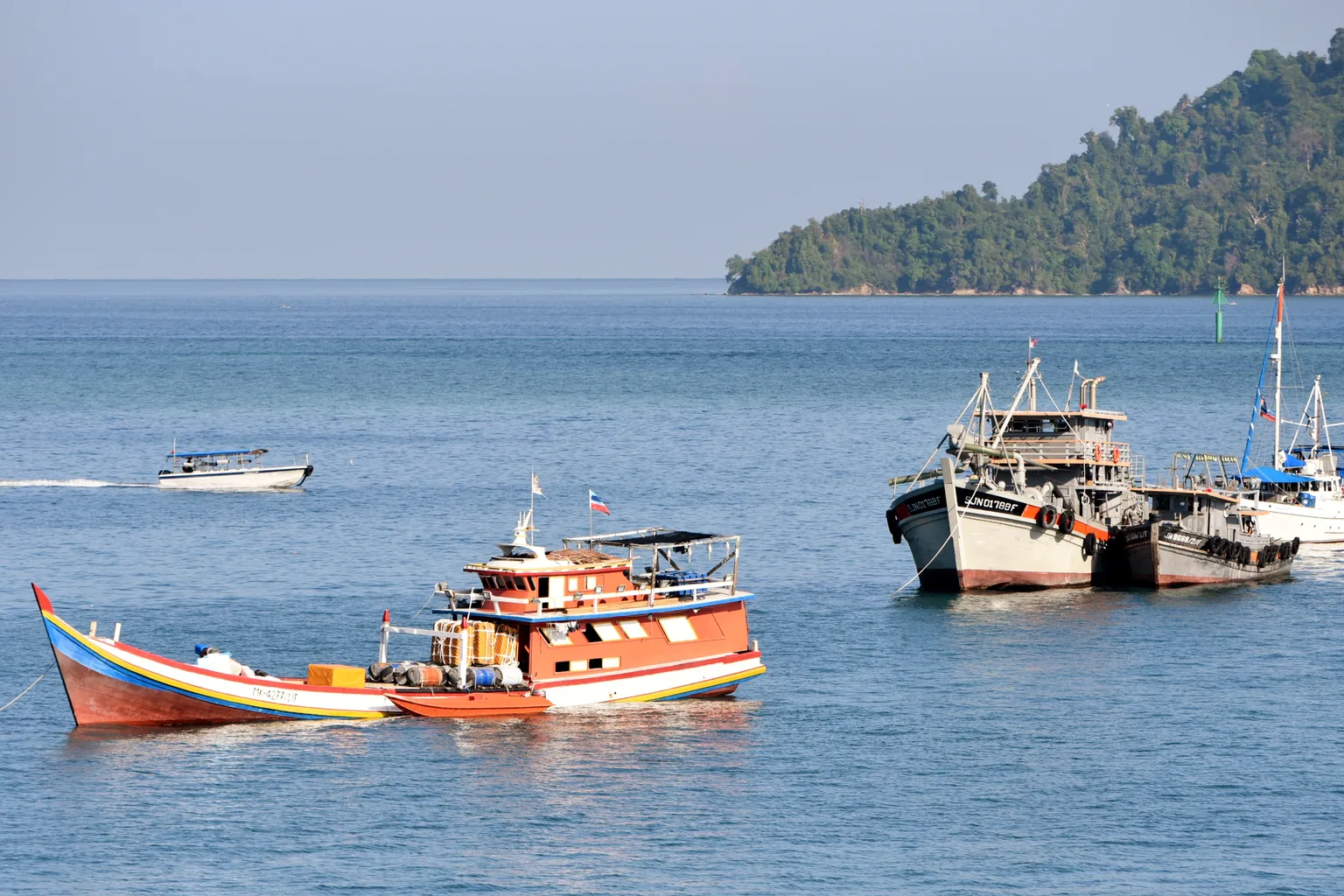
In March 2025 two fishing boats, called Vessel A and Vessel B in official slides, met at sea and transferred fish between them. They held a speed of 1 knot, about 25 to 30 metres apart. At 7.20pm on 11 March, Vessel A left for Kedah at 5 to 8 knots. It arrived at 5.20pm on 26 March.1
The speeds and times came from tracking data. Malaysia’s Department of Fisheries (DOF) monitors fitted boats 24 hours a day through satellite transmitters and the Automatic Identification System (AIS), a radio beacon that broadcasts a vessel’s position.1 In November 2025 DOF showed the track to regional officials in Bangkok under the heading “Example: VMS data analysis for transshipment”. It also gave the reason: the transfer happened “because Vessel A experienced a malfunction”.1 The slides do not suggest any offence.
Since 15 June 2026, a transfer like that needs paperwork. The Fisheries (Amendment) Act 2025, in force from that day, added Section 10A. Owners, masters and crews of Malaysian fishing boats may not tranship in Malaysian waters or on the high seas without the Director-General’s written approval, unless the activity is licensed.234 In 2026 slides, DOF listed “limited training, experience, and expertise in analyzing VMS data” among its problems. It proposed “AI-powered analytics” as a fix.3 Our agriculture article covers DOF’s 2019 loss estimate, camera-guided fish feeders and the global map of untracked fishing fleets. The eFishery fraud is in our articles on venture capital and unicorns.
The short version
- Malaysia landed 1.39 million tonnes of marine fish in 2025, 11.5% below the 2016 peak. Fishers on licensed boats fell to 96,008, a third fewer than in 2013, and 23.8% of them are foreign.
- Agencies detained 478 foreign vessels in 2020–2025, 331 of them involving Vietnamese nationals. Two official loss estimates differ by up to 29-fold, and DOF lists working out a method among its tasks.
- The maritime agency runs 15 radar stations and has no surveillance satellite of its own. DOF reports limited expertise in analysing its tracking data.
- Fish farms produced 500,156 tonnes in 2025, 79% of the national target. AI pilots on Malaysian farms have published no yield or survival figures.
- AI at sea has documented limits. Radar satellites catch most objects over 15 metres, and a model meant to flag forced labour could profile only 21 of 193 known abuse vessels.
A track becomes evidence
A vessel monitoring system (VMS) reports where a boat is, and when. DOF’s uses two devices, a satellite transmitter and an AIS Class B radio, watched at its Vessel Monitoring Centre.1 Around it sit e-Lesen for licences, e-Logbook for catch records, and e-PSM, which handles foreign fishing vessels’ requests to enter Malaysian ports. e-PSM approves regular applications automatically.13
DOF lists sharing its VMS analysis with enforcement agencies, to detect encroachment into fishing zones, among its strategies. With AFMA, Australia’s fisheries authority, it has held a VMS analysis workshop on spotting “abnormal behavior of fishing pattern” in vessel tracks.1 The zones are set by distance offshore. Zone A reaches 5 nautical miles, B 12, C 30 and C2 200, and C3 is international waters.5
The tracking serves a wider plan. DOF says its second national plan against IUU fishing, NPOA-IUU 2.0, builds on a 2013–2017 plan and has been endorsed by a steering committee chaired by the ministry’s secretary-general.3 Under PATKOR OPTIMA, Malaysia and Indonesia share information on fishing in the Strait of Malacca.1 DOF’s key actions include tracking abnormal behaviour by local boats through VMS, and blocking fish from IUU fishing at national entry points.3
The 2025 amendment raises the stakes. Catching fish with explosives, poison, electric current or prohibited gear now carries a fine of up to RM250,000, up to five years in prison, or both. A separate maximum fine, in section 25 of the 1985 Act, rises to RM100,000, from RM20,000. Anyone whose licence is cancelled can be barred for up to five years from applying again. The Act received Royal Assent on 16 December 2025 and was gazetted on 31 December.2
How machines watch the sea
Three kinds of signal show where boats are. AIS is a public radio broadcast. VMS is a private feed that boats send to the government, and its data are often proprietary.6 Both fail if a boat lacks the device or switches it off. “Vessels engaged in illicit activities often turn off their AIS transponders or manipulate the locations they broadcast,” a Nature study noted in January 2024. The largest recent illegal fishing cases, its authors add, involved fleets that mostly did not use AIS.6
The third signal needs no help from the boat. Synthetic-aperture radar (SAR) satellites bounce microwaves off the sea, and SAR “is unaffected by light levels and most weather conditions”.6 The Nature team, led by Global Fishing Watch, analysed 2 petabytes of radar and optical images spanning 2017–2021. They covered more than 15% of the ocean, where over 75% of industrial activity takes place.6
No person could check that many pictures. The team trained three deep convolutional neural networks, a kind of AI that learns visual patterns from labelled examples. One found objects with over 97% accuracy; another told fishing vessels from others with over 90% accuracy. A third separated oil and wind structures with over 98% accuracy. Together they classified more than 67 million image tiles.6 The team then matched detections against 53 billion AIS positions. A boat seen by radar but absent from AIS was “not publicly tracked”, sometimes called a dark vessel.6 The maps also caught the pandemic: global fishing fell 12% at its onset in 2020 and had not recovered by 2021.6 Our agriculture article gives the study’s headline result.
- 1SatelliteRadar images the seaSentinel-1 satellites take radar images that work in darkness, cloud and rain.
- 2AI modelA network finds objectsA deep neural network spots objects with over 97% accuracy; the models classify more than 67 million image tiles in all. Most objects over 15 metres are caught.
- 3AI modelA second network sorts themVessels are classed as fishing or non-fishing with over 90% accuracy; another model separates oil and wind structures.
- 4Data pipelineDetections meet AISEach detection is matched against 53 billion AIS positions. Unmatched vessels are not publicly tracked.
- 5Analysts and patrolsApprovalA lead, not proofNot all vessels must carry AIS, so an unmatched boat needs checking before anyone acts.
Radar detects over 70% of 25-metre vessels and over 90% of those 50 metres or longer. The last step describes how such leads are used; the study itself maps activity.
Source: Paolo et al., Nature (3 January 2024).
Show the numbers
| Step | Who | What | Detail |
|---|---|---|---|
| 1 | Satellite | Radar images the sea | Sentinel-1 satellites take radar images that work in darkness, cloud and rain. |
| 2 | AI model | A network finds objects | A deep neural network spots objects with over 97% accuracy; the models classify more than 67 million image tiles in all. Most objects over 15 metres are caught. |
| 3 | AI model | A second network sorts them | Vessels are classed as fishing or non-fishing with over 90% accuracy; another model separates oil and wind structures. |
| 4 | Data pipeline | Detections meet AIS | Each detection is matched against 53 billion AIS positions. Unmatched vessels are not publicly tracked. |
| 5 | Analysts and patrols | A lead, not proof (approval) | Not all vessels must carry AIS, so an unmatched boat needs checking before anyone acts. |
Two details matter for Malaysia. About 67% of all vessel activity mapped was in Asia, and 86% of fishing took place in waters under 200 metres deep.6 But radar has a size limit. It captures “most objects larger than 15 m”, the authors write: over 70% of 25-metre vessels and over 90% of those 50 metres or longer.6
Some of the tools are free. Skylight, run by the Allen Institute for AI, says its vessel-tracking software is free to governments and non-governmental organisations.7 Global Fishing Watch publishes VMS data shared by ten countries, starting with Indonesia in June 2017. Malaysia is not among them.8
Cameras that count the catch
AI can also ride on the boat. In an April 2026 report, The Nature Conservancy (TNC) and the software firm Tryolabs described deck cameras on a tuna longliner in the Eastern Tropical Pacific. A compact Nvidia computer on board ran a model trained on over one million images from 29 hauls.9 Managers received “species-level catch counts and fishing risk profiles within hours of each hauling event”, with people verifying the results.9 The team compared the counts with expert reviews of the footage by Bureau Veritas, an inspection firm, and with captains’ electronic logbooks over five days of fishing.9
The model counted kept fish well, missing 6%, inside the 10% miss rate TNC set as its bar for operational use. Fish thrown back were harder. For discards on deck it missed 40%, and 57% of its detections were wrong, though the test set held few such events.9
| Product | Missed events | Wrong detections | Within the 10% miss bar | Verdict |
|---|---|---|---|---|
| Retained catchFish kept on board | 6% | 2% | Yes | ✓Usable |
| Water discardsFish released at the waterline | 23% | 29% | No | ✕Not yet |
| Vessel discardsFish thrown back from deck | 40% | 57% | No | ✕Not yet |
Wrong detections are the share of AI detections that matched no real event. TNC set a 10% miss rate as its threshold for operational use. Discard events in the test set were few, so those rates are uncertain.
Source: The Nature Conservancy and Tryolabs, Monitoring Fishing Activity on the Edge (April 2026).
Show the numbers
| Product | Missed events | Wrong detections | Within the 10% miss bar | Verdict |
|---|---|---|---|---|
| Retained catch | 6% | 2% | Yes | Usable |
| Water discards | 23% | 29% | No | Not yet |
| Vessel discards | 40% | 57% | No | Not yet |
The world’s catch stopped growing
Wild fishing hit a ceiling long ago. Capture fisheries landed about 92 million tonnes in 2024, the UN Food and Agriculture Organization (FAO) said in June 2026. They “have remained within the 86–94 million tonnes range since the late 1980s”.10 Growth comes from farms. In 2024 aquaculture produced 103 million tonnes of aquatic animals, passing 100 million for the first time. Trade reached US$184 billion, about RM752 billion, rivalling meat. FAO expects total aquatic animal production to reach 214 million tonnes by 2034.10
Most wild fish still come from healthy stocks: 72.6% of 2023 landings, FAO says.10 Illegal, unreported and unregulated (IUU) fishing covers boats fishing without permission, catches never declared and fishing where no rules apply. The European Commission estimated in 2019 that it takes 11 to 26 million tonnes a year, worth €10–20 billion (about RM45–90 billion), or at least 15% of world catches.11 Karmenu Vella was the EU’s fisheries commissioner in January 2019. “Illegal, unreported and unregulated fishing damages global fish stocks but it also hurts the people living from the sea, especially those already vulnerable to poverty,” he said.11
Importers apply pressure through trade. The EU, the world’s biggest importer of fisheries products, can warn a country with a “yellow card” that may lead to an import ban. Thailand received one in April 2015; it was lifted in January 2019.11 Vietnam had held one for “nearly eight years” by February 2026, Viet Nam News reported.12 By August it had faced five EU inspections. A plan approved on 10 August requires every trip by vessels of 6 metres or longer to be logged electronically. Boats with missing data get no catch certificates, VnEconomy reported.13 The card matters to Malaysia because most foreign boats detained here are Vietnamese.
Malaysia’s catch, boat by boat
Malaysia landed 1,393,398 tonnes of marine fish in 2025, worth RM11.89 billion at wholesale prices and RM16.18 billion at retail.14 That was 11.5% below the 2016 peak of 1,574,446 tonnes, by our arithmetic. The 2023 total of 1,270,277 tonnes was the lowest since 2005.1415 The figures cover only establishments registered with DOF, so subsistence fishing is missing.14 Counting farms and rivers, Malaysia produced 1.91 million tonnes of fish in 2024, and DOF valued the industry at RM16.9 billion. Sea fishing supplied 72.8% of the weight and aquaculture 26.7%.5
Annual totals are our sums of monthly figures. They cover establishments registered with the Department of Fisheries only.
Source: DOSM (OpenDOSM), fish landings dataset, from DOF data (updated 10 October 2026).
Show the numbers
| Period | Marine landings |
|---|---|
| 2005 | 1,210 |
| 2006 | 1,372 |
| 2007 | 1,381 |
| 2008 | 1,394 |
| 2009 | 1,393 |
| 2010 | 1,429 |
| 2011 | 1,373 |
| 2012 | 1,472 |
| 2013 | 1,483 |
| 2014 | 1,458 |
| 2015 | 1,486 |
| 2016 | 1,574 |
| 2017 | 1,465 |
| 2018 | 1,453 |
| 2019 | 1,455 |
| 2020 | 1,383 |
| 2021 | 1,328 |
| 2022 | 1,308 |
| 2023 | 1,270 |
| 2024 | 1,392 |
| 2025 | 1,393 |
Most fish come from near shore. In 2025 inshore waters, within 30 nautical miles, gave 1,188,023 tonnes and the deep sea gave 205,375 tonnes, or 14.7%.15 The mix has shifted. Zone A, the strip nearest shore, yielded 431,200 tonnes in 2024, against 290,400 in 2008. The deep-sea zone, C2, fell to 153,900 tonnes in 2022, from 376,500 in 2016, before recovering to 210,100.5 DOF says deep-sea landings rose 25% in 2024. Deep-sea vessels rose 10.8% that year, to 812, while inshore vessels fell 12.9%.5
nm is nautical miles from shore. Zone C3, international waters, landed 4,100 tonnes in 2008 and 400 tonnes in 2024.
Source: Department of Fisheries Malaysia, Kompendium Data 2024 (2025).
Show the numbers
| Item | 2008 | 2024 |
|---|---|---|
| Zone A (0–5 nm) | 290.4 | 431.2 |
| Zone B (5–12 nm) | 424.6 | 277.6 |
| Zone C (12–30 nm) | 375.2 | 472.6 |
| Zone C2 (30–200 nm) | 300.3 | 210.1 |
Trawl nets, dragged through the water or along the seabed, landed 629,531 tonnes in 2025, or 45.2% of the total.14 Selayang, or scad, is the most-landed fish in five states, DOF says. Fishers landed 94,234 tonnes of it in 2024, worth RM592 million; pelaling, at 79,685 tonnes, fetched RM897 million.5 Mackerel catches, pelaling and kembung together, fell by 30.6% between 2015 and 2025, by our arithmetic.14
The fleet is shrinking, and most of it is small. Licensed fishing vessels numbered 49,173 in 2023, 43,012 in 2024 and 40,165 in 2025.515 Two-thirds have outboard engines; only 591 are 70 gross registered tonnes (GRT) or more.15 Small boats, or sampan, explain most of the 2024 fall. Their number dropped by 5,520, and Sabah’s alone by 4,840.5 DOF does not say whether boats left the sea or the register was cleaned up.
The remainder are inboard-engine vessels under 70 GRT, long-tail or pump-engine boats, and unpowered boats. Shares are our arithmetic.
Source: Department of Fisheries Malaysia, Perangkaan Perikanan 2025 Jilid 1, Table 2.1 (August 2026).
Show the numbers
| Share | What |
|---|---|
| 66.8% | have outboard engines (26,845 of 40,165 vessels) |
| 1.5% | are 70 gross registered tonnes or larger (591 vessels) |
Dearer fish, more imports
Fish prices have outrun prices in general. DOSM’s consumer price index for fish and seafood averaged 167.5 in 2025, against 100 in 2010, a rise of 67.5%. Overall prices rose 34.6%, by our arithmetic from DOSM data.16 The average wholesale value of a kilo landed rose 36% between 2015 and 2025, to RM8.53. The 2025 catch was worth 36% more at retail than at wholesale, by our arithmetic.14
Annual averages of monthly indices are our arithmetic. The fish and seafood index averaged 169.8 in January–September 2026.
Source: DOSM (OpenDOSM), consumer price index by class and division (data to September 2026).
Show the numbers
| Period | Fish and seafood | All items |
|---|---|---|
| 2010 | 100.0 | 100.0 |
| 2011 | 105.7 | 103.2 |
| 2012 | 112.7 | 104.9 |
| 2013 | 118.8 | 107.1 |
| 2014 | 124.5 | 110.5 |
| 2015 | 129.8 | 112.8 |
| 2016 | 138.0 | 115.1 |
| 2017 | 147.3 | 119.5 |
| 2018 | 151.1 | 120.7 |
| 2019 | 152.5 | 121.5 |
| 2020 | 153.6 | 120.1 |
| 2021 | 158.4 | 123.1 |
| 2022 | 164.3 | 127.2 |
| 2023 | 167.2 | 130.4 |
| 2024 | 164.6 | 132.8 |
| 2025 | 167.5 | 134.6 |
Cheap fish nearly double in price between boat and shop; dear ones rise less. Selayang, or scad, averaged RM5.66 a kilo at landing in 2025 and RM10.70 at retail. Large grouper went for RM27.44 and RM36.30.15
| Fish | At landing | Wholesale | Retail | Retail ÷ landing |
|---|---|---|---|---|
| Selayang (scad) | 5.66 | 7.53 | 10.70 | 1.89 |
| Pelaling (short mackerel) | 8.20 | 11.06 | 15.03 | 1.83 |
| Siakap (seabass) | 15.78 | 18.07 | 22.54 | 1.43 |
| Tenggiri (Spanish mackerel) | 19.91 | 22.18 | 29.22 | 1.47 |
| Kerapu besar (large grouper) | 27.44 | 30.19 | 36.30 | 1.32 |
Source: Department of Fisheries Malaysia, Perangkaan Perikanan 2025 Jilid 1, Tables 6.1–6.3. Ratios are our arithmetic.15
Malaysia buys more fish than it sells. In 2024 it imported 662,184 tonnes of fisheries products worth RM6.58 billion and exported 403,007 tonnes worth RM4.39 billion, a deficit of RM2.19 billion.17 Fresh, chilled and frozen fish was the largest import, at RM2.15 billion. Shrimp was the exception: exports of RM847 million beat imports of RM669 million.17
Appetites are large. DOF slides labelled “DOF statistics 2024” put consumption at 44.7 kg a person a year and self-sufficiency at 90.7%.1 Its 2024 compendium charts those as the 2023 values and gives 48.1 kg and 91.6% for 2024, by our reading of the chart.5 Either way, Malaysians eat more than twice the world average supply, which FAO put at 21.1 kg a person in 2023.10
Foreign boats and a gap of up to 29-fold
In a written reply dated 21 January 2026, Home Minister Datuk Seri Saifuddin Nasution Ismail gave Parliament a count. Enforcement agencies had detained 478 foreign vessels between 2020 and 2025. Of these, 331, or 69.25%, involved Vietnamese nationals.18 He said agencies use the Sea Surveillance System, a radar network, and AIS to detect suspicious movement. Offshore patrol vessels such as KM Bendahara patrol up to 200 nautical miles out.18
The government takes the encroachment of national waters by foreign fishing vessels seriously, particularly the persistent issue involving Vietnamese vessels.
Other counts use other units and periods. The agriculture minister reported 515 arrests of foreign fishermen in 2020–2024, 367 of them Vietnamese.19 Op Naga, a joint operation, detained 598 foreign fishing vessels between May 2019 and September 2024, according to a Bernama headline; the full report is not public.20 DOF’s IUU committee had classified 63 foreign vessels as IUU vessels by July 2025, 45 of them Vietnamese. In November DOF said it had “updated 81”.119
| Count | What it counts | Period | Reported by |
|---|---|---|---|
| 478 | Foreign vessels detained by enforcement agencies; 331 involved Vietnamese nationals | 2020–2025 | Home Minister |
| 515 | Arrests of foreign fishermen encroaching on Malaysian waters; 367 Vietnamese | 2020–2024 | Agriculture minister |
| 598 | Foreign fishing vessels detained in Op Naga | May 2019 to September 2024 | Bernama (headline) |
| 81 | Foreign vessels on DOF’s IUU list (63 in July 2025) | To November 2025 | DOF |
| 28 and 3 | Foreign fishing vessels detected, and apprehended, in one state director’s account | 2025, to mid-December | Maritime agency, Kelantan |
Source: The Star (22 January 2026; 29 July 2025); Bernama (17 October 2024); DOF (24–26 November 2025); Malay Mail (14 December 2025).118192021
Seeing a boat is not catching it. In December 2025 the Malaysian Maritime Enforcement Agency’s (MMEA) Kelantan director, Capt Erwan Shah Soahdi, said 28 foreign fishing vessels had been detected in national waters that year. Three were apprehended, with 17 crew.21 He named two hotspots: the Malaysia–Vietnam Commercial Arrangement Area and the Malaysia–Thailand Joint Development Area. Stolen catch is “mostly sent back to the vessels’ countries of origin”, he said.21 In 2024, he added, 15 foreign boats were seized in east coast waters and 134 crew detained, with seizures worth RM9.9 million.21
What a seizure looks like
Reports of single cases show the pattern. In April 2025 MMEA intercepted two Vietnamese boats with 12 crew, 11 nautical miles northeast of Pulau Sibogor off Kudat, Sabah. It put the seizures at over RM4 million.22 In May 2025 a Vietnamese boat was stopped about 105 nautical miles from the Tok Bali estuary in Kelantan, carrying about 300 kg of seafood and five crew. The assets seized were worth nearly RM100,000, Bernama reported.23
Nobody agrees what the poaching costs. In 2019 DOF said illegal fishing cost Malaysia RM3 billion to RM6 billion a year, some 980,000 tonnes of fish, a figure our agriculture article also covers.24 In March 2024 the agriculture minister put the losses from 428 cases of encroachment by foreign fishing boats in 2020–2023 at RM823.88 million, from RM238.69 million in 2021 to RM159.77 million in 2023.25 That averages about RM206 million a year, a fifteenth to a twenty-ninth of DOF’s range, by our arithmetic. In July 2025 he repeated the RM823 million figure beside arrest counts for 2020–2024.19
The first figure covered illegal fishing as a whole; the second, only foreign encroachment cases. Neither was published with a method. In November 2025 DOF listed, among its own strategies, the need to “formulate methodology” to estimate losses from IUU fishing.1
Radar, drones and an AI plan
MMEA watches the coast with 15 radar stations under Swasla, the Sea Surveillance System: 12 along the Strait of Melaka and three off Sabah’s west coast.26 On 5 November 2026 Deputy Home Minister Datuk Seri Shamsul Anuar Nasarah told Parliament that the stations operate around the clock. He added that they do not cover all Malaysian waters, so ships and boats patrol beyond them.26
Gaps remain. A second phase covering Pulau Malawali and Sandakan has been approved, with a tender expected by year-end, while a Sarawak study still awaits the Economy Ministry. MMEA has no dedicated satellite for continuous surveillance; the satellite technology it uses mainly supports search and rescue, Shamsul said.26 He listed other gaps: too few drones and aircraft, and a lack of long-range vessels, fast interceptors and an integrated command system. MMEA is buying two vessels that carry drones.26 Shamsul described a shift away from a “detect-and-act” approach, towards early detection, target identification and rapid response.26
AI is the next layer, so far on paper. In January 2025 MMEA was chosen as one of the Home Ministry agencies to pioneer AI in its operations.27 Its director-general had said in November 2024 that new radars would be integrated with AI under a maritime domain awareness system.28 On 29 June 2026 Shamsul said the ministry was evaluating predictive AI and would gradually add drones, under its AI Strategic Plan 2026–2030. The question concerned smuggling around Langkawi. “This technology will enhance early detection of suspicious boat movements,” he said of the drones.29
The tighter limits are people and boats. DOF’s 2026 slides list “insufficient assets such as patrol vessels, drones, and monitoring equipment” beside its limited expertise in analysing VMS data.3 Radar satellites detect most vessels over 15 metres, while two-thirds of the licensed fleet are outboard boats; DOF’s tables class boats by engine and tonnage, not length.615 In the Kelantan account, detections outnumbered apprehensions about nine to one, by our arithmetic.21 More detections help only if there are boats to send.
Fish farms: shrimp pays, seaweed weighs
Malaysia’s fish farms produced 500,156 tonnes in 2025, worth RM4.41 billion wholesale. Freshwater farms gave 115,107 tonnes, brackish and marine farms 385,048.15 Seaweed made up 42.4% of the tonnage, almost all of it from Sabah, but 1.5% of the value. Farmed shrimp was 11.4% of the weight and 34.8% of the value, by our arithmetic. White shrimp gave 36,309 tonnes worth RM880.5 million, and tiger prawns 20,739 tonnes worth RM654.4 million. Seabass, or siakap, was the top farmed fish: 58,221 tonnes worth RM755.3 million.15
Seaweed is counted at wet weight. Shrimp is white shrimp plus tiger prawn. Shares are our arithmetic.
Source: Department of Fisheries Malaysia, Perangkaan Perikanan 2025 Jilid 1, Tables 14.1–14.8 (August 2026).
Show the numbers
| Item | Seaweed | Farmed shrimp | Everything else |
|---|---|---|---|
| Share of tonnage (500,156 t) | 42.4 | 11.4 | 46.2 |
| Share of value (RM4.41bn) | 1.5 | 34.8 | 63.7 |
Sabah has farmed seaweed since the 1970s, says Seadling, a seaweed firm. It says the crop is harvested every 45 days, that it has trained more than 300 farmers, and that it has run a factory in Tuaran since 2018.30 The state’s fisheries minister said in May 2026 that Semporna’s seaweed products had reached the United States, Europe and Japan.31 Prices are the weak point. In 2024 the crop’s value fell 29.2%, to RM71.3 million, while its tonnage fell 2.1%.5
The farms are behind plan. The national agrofood policy, DAN 2.0, set aquaculture targets of 630,000 tonnes for 2025 and 958,500 for 2030, a DOF chart shows.5 The 2025 harvest reached 79% of its target, by our arithmetic. Registered fish farmers fell 22.2% in 2024, to 16,102, and freshwater farmers by 29.2%.5 DOF’s tables give no reason. Budget 2027 sets aside RM40 million for aquaculture projects, which LKIM, the fisheries development authority, says could widen fishermen’s business opportunities.32
AI on the pond: claims without results
On Malaysian ponds, AI often starts with a sensor and an alarm. The National Fishermen’s Association (NEKMAT) is looking at spending about RM300,000 on AI for its white shrimp ponds in Badong, Pekan, Bernama reported on 30 August 2026. Sensors and phone apps would track water quality, oxygen and temperature, and set feed amounts.33 Its four ponds produced 58 tonnes worth RM1.4 million in 2025, run semi-manually. “If the power supply goes out, oxygen levels drop or any parameter changes, the system will warn us,” said Azrin Shah Ismail, its general manager. NEKMAT is building nine more ponds on about 15 acres for RM5 million, and hopes automatic monitoring will draw young people and graduates into the work.33
FishSpeak, from Pacton Technologies, combines computer-vision models, which read camera images, with AI advice for fish and shrimp farms. In May 2026 the government-backed VentureTECH invested an undisclosed sum. The companies say FishSpeak is deployed at more than 50 aquaculture sites through MDEC’s Digital AgTech Programme.34 They claim “measurable operational improvements” in pilots, including better feed efficiency and earlier risk detection, without publishing figures.34 Faisal Shadli, Pacton’s founder, framed it as access. “FishSpeak was built to make advanced AI accessible at the farm level, using computer vision and familiar tools such as WhatsApp to help operators make faster, better, and more data-driven decisions.”34
Universities are building cheaper kit. Universiti Malaysia Pahang Al-Sultan Abdullah (UMPSA) says its iSenseFishery system targets uncertain water quality, high costs and hard-to-monitor ponds. It sends sensor data to the cloud for machine-learning analysis. Its prototype cost about RM10,000, and the target price is RM1,000 to RM3,000.35 Universiti Malaya’s AquaRover, a solar floating robot, cleans ponds and measures pH, temperature and ammonia. It received RM222,000 from a Finance Ministry grant and was tested at Pahang hatcheries, says a Focus Malaysia article by a Universiti Malaya postgraduate. The article says farmers reported better growth and feed conversion, without giving numbers.36 None of these projects has published yield or survival figures.
Abroad, the claims are bigger and still the companies’ own. Norway’s Aquabyte says it has more than 800 underwater camera systems in pens, counting sea lice automatically and processing over a million images a day.37 The founder of India’s AquaExchange says its system predicts shrimp disease risk three to four days before symptoms appear, cutting mortality losses by 40–50%. He says underwater microphones that listen to feeding improve feed efficiency by about 10%.38 Umitron’s camera-guided feeders are in our agriculture article, and eFishery’s inflated device counts are a warning for anyone buying on a vendor’s word.
Who works the boats
Fewer people work the licensed fleet. Fishers on licensed vessels numbered 144,019 in 2013 and 96,008 in 2025, a third fewer.15 In 2025, 22,860 of them, or 23.8%, were foreign, and the largest group was Thai, at 8,338. DOF counts permanent residents among its foreign fishers. In Perak, 5,190 of 13,854 fishers, or 37%, were foreign, by our arithmetic. Sabah’s licensed fishers numbered 31,300 in 2023 and 26,675 in 2025; Kedah’s fell to 5,563 in 2025, from 8,510 in 2024.15
Licensed vessels only. Crews of unlicensed boats and subsistence fishers are not counted.
Source: Department of Fisheries Malaysia, Perangkaan Perikanan 2025 Jilid 1, Table 1.4 (August 2026).
Show the numbers
| Year | Fishers |
|---|---|
| 2013 | 144,019 |
| 2014 | 144,421 |
| 2015 | 140,949 |
| 2016 | 132,305 |
| 2017 | 130,645 |
| 2018 | 128,148 |
| 2019 | 126,595 |
| 2020 | 119,828 |
| 2021 | 114,979 |
| 2022 | 116,613 |
| 2023 | 112,344 |
| 2024 | 105,287 |
| 2025 | 96,008 |
How many work under coercion is unknown. We found no survey of forced labour on Malaysian fishing boats. A 2026 ILO survey estimated that 20% of migrant fishers were in forced labour, against 0.4% of seafood-processing workers. Its destinations included China, Japan, South Korea, Taiwan and Thailand; Malaysia is not named.39 The US State Department kept Malaysia on Tier 2 in its 2025 trafficking report, saying the government “demonstrated overall increasing efforts compared with the previous reporting period”. Its Malaysia chapters for 2024 and 2025 do not mention fishing, by our search of the text.4041 A missing measurement is not evidence that the problem is absent.
In November 2025 the EU-funded Ship to Shore Rights programme, run by the ILO, extended to Malaysia for 2025–2028. It covers fishing, seafood processing and aquaculture. Malaysia’s seafood exports were worth nearly US$1 billion in 2023, nearly RM4.1 billion, the ILO notes.42 The ILO says national law and enforcement will be improved for greater alignment with standards such as the Work in Fishing Convention (No. 188). It does not say Malaysia has ratified that convention.42 Thailand had announced ratification by January 2019, the first country in Asia to do so.11
We recognize the specific vulnerabilities of foreign workers in the fishing, seafood processing and aquaculture sectors, and protecting their labour rights remains a priority.
AI has been tried on the problem. A 2020 study in PNAS trained a machine-learning model on AIS tracks from Global Fishing Watch. It flagged 14% to 26% of 16,000 industrial longliners, squid jiggers and trawlers as high-risk, with 57,000 to 100,000 people aboard. Engine power, distance from port, voyages a year and daily fishing hours mattered most.43 Critics replied in 2021 that of 193 known abuse vessels, only 58 used AIS and 21 had usable profiles. Nearly 90% of known cases were thus invisible to the method, and the same 21 cases trained and validated the model, they wrote.44 The authors answered that they had used ten-fold cross-validation, with separate validation subsets.45 The Nature authors make the same point about the largest forced-labour cases.6 Recruitment and debt bondage are covered in our article on foreign workers.
A thinner, warmer sea
Beneath the technology is a depleted stock. In March 2026 DOF’s director-general, Datuk Adnan Hussain, told The Star that local studies found at least 83% of bottlenose wedgefish, a ray, caught in Malaysian waters are juveniles. He did not name the studies. The giant guitarfish appeared in Kota Kinabalu landing records twice in 2018 and once in 2021.46 Snappers are now overexploited in coastal areas, he said, and large, mature Spanish mackerel are increasingly hard to find. The humphead wrasse is “almost not found” in many reef areas. A single trawl can destroy up to 20% to 25% of the marine life in an area. “Even with strong protection measures, recovery could take several decades,” he said of slow-breeding species.46
Surveys indicate that catch rates in some areas have fallen by as much as 96%, with total quantity now reduced to about 6% of original levels.
Nearly 1,000 trawling-related offences were recorded in 2020–2025, Adnan said.46 Protection is thin. Marine protected areas cover 5.39% of Malaysia’s waters, 29,076 square kilometres, against a target of 10% by 2030, a deputy minister told the Senate in September 2025. Fifteen fishing licences were revoked in 2020–2024, he said.47
Warming adds pressure. A model led by Universiti Malaysia Terengganu researchers, published in April 2026, assumes high emissions. It projects sea surface warming of about 1.3°C in the South China Sea over 1990–2060. It finds plankton biomass, the base of the food web, falling by up to 19.9% by mid-century. It studied three upwelling zones, off Vietnam, the east coast of Peninsular Malaysia and Sabah.48 The authors note it is “a single regional-scale model driven by a single global climate model”.48 Bleaching-level heat stress hit about 84.4% of the world’s coral reef area between January 2023 and September 2025, with mass bleaching in at least 83 countries and territories, NOAA says.49 FAO projects exploitable fish biomass falling by over 10% by 2050 in several regions under high emissions.10 The Star’s report on Malaysian stocks lists rising sea temperatures, coral bleaching and acidification alongside overfishing.46
What worked and what didn’t
The successes paired tracking with law, people and market pressure. The failures relied on data that was missing, switched off or never published.
Worked
Thailand’s yellow card lifted
The EU warned Thailand in April 2015 and lifted the card on 8 January 2019. Thailand rewrote its fisheries law, set deterrent sanctions and added remote monitoring of fishing and inspections at port. As a party to the FAO port-state treaty, it tightened checks on foreign landings. It also announced ratification of the ILO’s Work in Fishing Convention.11
Why it worked: the world’s biggest fish importer pressed, and Thailand answered with law, tracking and port checks together.
Worked
Indonesia opened its data
Indonesia’s crackdown on foreign illegal boats cut total fishing effort by at least 25%, a 2018 study found. Its model suggests curbing IUU fishing could raise catch by 14% and profit by 12%, where typical reforms would cut them by 15% and 16%.50 In June 2017 Indonesia became the first country to publish its VMS data through Global Fishing Watch.8
Why it worked: political will, plus data that outsiders could check.
Worked
Deep learning maps the dark fleet
The 2024 Nature study used free Sentinel imagery, three neural networks and 53 billion AIS positions to map industrial fishing that broadcasts nothing. Its fishing classifier was over 90% accurate.6
Why it worked: public satellite data and a narrow question. The limit is size: boats under 15 metres are often missed.
Worked
Counting kept fish at sea
On a tuna longliner, TNC and Tryolabs’ on-board model missed 6% of retained catch, and 2% of its detections were wrong. Daily reports went ashore by satellite internet within hours of fishing.9
Why it worked: one narrow task, a million labelled images, and a person checking the output.
Worked
Malaysia’s tracker saw the transfer
DOF’s VMS reconstructed the March 2025 transfer down to speed and distance between hulls.1 Since 15 June 2026, Section 10A has required written approval for such transfers.34
Why it worked: transmitters already on the boats, a centre watching around the clock, and now a rule to apply the data to.
Didn’t work
Finding forced labour from orbit
The 2020 PNAS model flagged up to 26% of 16,000 vessels as high-risk. Only 21 of 193 known abuse vessels had usable AIS profiles, and those same cases trained and tested it, critics wrote; the authors say they cross-validated.434445
Lesson: a score built on AIS cannot see boats that never switch it on.
Didn’t work
AI boxes switched off at night
On smaller vessels, crews cut power to the on-board computer in the evening to save energy. In TNC’s test cases, 21% to 45% of footage went unprocessed, and the counts fell short until the full video was reprocessed offline.9
Lesson: on small boats, electricity limits AI more than the model does.
Didn’t work
Vietnam’s card stays
After nearly eight years and five EU inspections, Vietnam still had its yellow card in August 2026 and was tightening electronic catch logs.1213 Vietnamese nationals were involved in 331 of the 478 foreign vessels detained in Malaysia in 2020–2025.18
Lesson: monitoring rules count only when the data behind catch certificates holds up.
Things you probably didn’t know
- Almost a fifth of the catch is “trash fish”. Small, low-value fish sold mainly for feed made up 18.7% of 2025 landings by weight but 2.4% of wholesale value, about RM1.11 a kilo, by our arithmetic.14
- Perak, not Sabah, lands the most fish. It landed 383,025 tonnes in 2025, 27.5% of the national total.14
- Seaweed imports outweigh the crop’s value. Malaysia imported 2,085 tonnes of seaweed worth RM110.2 million in 2024. Its farmed crop of 220,263 tonnes, at wet weight, was valued at RM71.3 million.517
- The world’s densest fishing, largely untracked, was off Korea. In 2017–2019 the western Korean Peninsula had about 40 fishing vessels per 1,000 square kilometres. Activity fell 85% when North Korea shut its borders during the pandemic.6
- Malaysia is missing from a port treaty’s list. FAO’s list of parties to the Port State Measures Agreement, in force since 5 June 2016, includes Cambodia, Indonesia, Myanmar, the Philippines, Thailand and Vietnam, but not Malaysia.51 DOF says it applies its own port-state procedures through e-PSM.3
- Malaysia has signed up to curb fishing subsidies. It accepted the WTO Agreement on Fisheries Subsidies on 26 February 2024; the agreement entered into force on 15 September 2025.52
- Fishers still get subsidised diesel. DOF’s director-general said in October 2026 that the diesel subsidy of RM1.65 a litre had helped cut fishing costs.32
What to do with this
None of this is legal or investment advice.
For fish and shrimp farmers
- Buy the alarm firstNEKMAT’s manager cites alerts for power cuts and falling oxygen.33 Check that sensors and alerts still work when mains power fails.
- Ask for pond numbersRequest feed conversion and survival rates per pond, before and after, rather than “measurable improvements”.34
- Record a baselineLog feed used, harvest weight and survival for each pond over a full cycle before installing anything, so any gain can be measured.
Questions to ask an AI vendor
- Which ponds or cages were in the pilot, and what were feed conversion and survival before and after?
- Who measured the results: the vendor, the farm or an independent party?
- What happens to alerts when mains power or mobile coverage fails?
- How many devices are installed and sending data today?
For investors and lenders
Treat site counts and device counts as claims until checked. KWAP lost its eFishery investment to fraud, as our unicorns article describes; eFishery had claimed far more feeders than an internal probe found. Ask for telemetry from installed devices, visit farms you choose yourself, and match revenue to bank records.
For boat owners and skippers
Since 15 June 2026, transhipment, landing at a port not named on your licence and repairs outside Malaysian waters need the Director-General’s written approval.24 Keep VMS and AIS running and logbooks complete. A cancelled licence can mean a bar of up to five years.2
For shoppers
Ask the species and the size. DOF’s director-general says most bottlenose wedgefish caught are juveniles and large Spanish mackerel are getting hard to find, so small fish of large species are part of the problem.46 Fish and seafood prices rose 67.5% between 2010 and 2025, against 34.6% for prices overall.16 Selayang and pelaling remain far cheaper than grouper.15
For policymakers
- Publish a method for IUU loss estimates, which DOF lists as its own task.1
- Consider sharing VMS data publicly, as ten countries do through Global Fishing Watch.8
- Measure working conditions on Malaysian boats; the 2026 ILO survey did not name Malaysia among its destinations.39
- Fund patrol assets and VMS training alongside any AI purchase; DOF and MMEA both list these gaps.326
What to watch to 2030
- By end-2026: the Swasla Phase Two tender for radar at Pulau Malawali and Sandakan.26
- 2026: Vietnam’s yellow card. Vietnam aims to have it lifted this year. A lift or a ban would change the pressure on its boats in Malaysian waters.13
- From 15 June 2026: the first cases under Section 10A and the RM250,000 penalty for destructive fishing.23
- 2027: Budget 2027 support. RM178 million for catch incentives and the fishermen’s cost-of-living allowance of up to RM300 a month, and RM40 million for aquaculture projects.32
- August 2027: DOF’s next statistics. The 2025 tables appeared in August 2026; the next set will show whether farms and the fleet recover.15
- 2025–2028: Ship to Shore Rights in Malaysia. Watch for migrant worker resource centres and law aligned with ILO Convention 188.42
- 2026–2030: the Home Ministry’s AI Strategic Plan, including predictive AI and more drones.29
- From September 2025: fisheries subsidy rules. The WTO agreement Malaysia accepted on 26 February 2024 is in force, while fishers’ diesel subsidy continues.3252
- 2026: the end of the fourth global bleaching event. It began on 1 January 2023, and NOAA said in June 2026 that it likely ended in 2025.49
- 2030: targets. 958,500 tonnes of aquaculture under DAN 2.0, and marine protected areas at 10%, from 5.39%.547
Detentions, arrests and loss estimates come from different agencies and periods and are not directly comparable. DOF and DOSM statistics cover registered establishments only. Company and project figures are their own claims, and calculations marked as ours are illustrative. Nothing here is legal or investment advice. Conversions use Bank Negara Malaysia’s middle rate of 17 November 2026: RM4.089 per US dollar and RM4.5008 per euro.
Sources
- Department of Fisheries Malaysia, MCS implementation presentation at a SEAFDEC workshop in Bangkok, 24–26 November 2025: seafdec.or.th
- Laws of Malaysia, Act A1780, Fisheries (Amendment) Act 2025, published in the Gazette 31 December 2025: faolex.fao.org
- Department of Fisheries Malaysia, “Malaysia’s Current Initiatives in Combating IUU Fishing”, SEAFDEC Indo-Pacific workshop, March 2026: seafdec.or.th
- RTM Berita, “Denda lebih tinggi, Akta Perikanan (Pindaan) 2025 perkukuh penguatkuasaan” (the amended Act took effect on 15 June), 16 June 2026: berita.rtm.gov.my
- Department of Fisheries Malaysia, Kompendium Data 2024, Perangkaan Perikanan Jilid 1, 2025: dof-prod.b-cdn.net
- Paolo et al., “Satellite mapping reveals extensive industrial activity at sea”, Nature, 3 January 2024: nature.com
- Skylight (Allen Institute for AI), homepage, accessed 17 November 2026: skylight.global
- Global Fishing Watch, transparency and VMS data sharing, accessed 17 November 2026: globalfishingwatch.org
- The Nature Conservancy and Tryolabs, “Monitoring Fishing Activity on the Edge”, April 2026: nature.org
- FAO, “SOFIA 2026: Global fisheries and aquaculture production reaches new highs”, 16 June 2026: fao.org
- European Commission, Commission lifts “yellow card” from Thailand, 8 January 2019: ec.europa.eu
- Viet Nam News, efforts to have the EC’s yellow card lifted, 25 February 2026: vietnamnews.vn
- VnEconomy, Vietnam targets removal of EU yellow card in 2026, 13 August 2026: en.vneconomy.vn
- Department of Statistics Malaysia (OpenDOSM), marine fish landings by state, gear, species and value, from DOF data, updated 10 October 2026: open.dosm.gov.my
- Department of Fisheries Malaysia, Perangkaan Perikanan 2025 Jilid 1, annual fisheries statistics, August 2026: dof-prod.b-cdn.net
- Department of Statistics Malaysia (OpenDOSM), consumer price index by class and division, data to September 2026, accessed 17 November 2026: open.dosm.gov.my
- Department of Fisheries Malaysia, Perangkaan Perikanan Jilid 2 2024, imports and exports, August 2026: dof-prod.b-cdn.net
- The Star, “Total of 478 foreign vessels detained between 2020 and 2025”, 22 January 2026: thestar.com.my
- The Star, Vietnamese fishermen most arrested for encroaching on Malaysian waters, 29 July 2025: thestar.com.my
- Bernama, “Op Naga: 598 Foreign Fishing Vessels Detained From May 2019 To September 2024”, 17 October 2024: bernama.com
- Malay Mail (Bernama), Kelantan MMEA flags joint areas as illegal fishing hotspots, 14 December 2025: malaymail.com
- Daily Express via Newswav, MMEA foils illegal fishing by Vietnamese vessels in Kudat waters, 7 April 2025: newswav.com
- Bernama, Vietnamese fishing boat detained off Tok Bali, 17 May 2025: bernama.com
- Malay Mail, “Fisheries Dept: Malaysia loses RM6b a year to illegal fishing”, 4 September 2019: malaymail.com
- The Star, “Over RM800mil lost to foreign fishing vessels in M’sian waters, says Mat Sabu”, 21 March 2024: thestar.com.my
- Malay Mail (Bernama), government expands Sabah sea surveillance system, 5 November 2026: malaymail.com
- The Star, MMEA chosen to pioneer AI tech in operations, 9 January 2025: thestar.com.my
- New Straits Times, MMEA to embrace AI for stronger maritime security, 25 November 2024: nst.com.my
- The Star, government mulls AI analytics and drones for northern waters, 29 June 2026: thestar.com.my
- Daily Express, Sabah eyes seaweed as next economic driver, 28 July 2026: dailyexpress.com.my
- Borneo Post, Sabah to strengthen fisheries and seaweed sectors in Semporna, 17 May 2026: theborneopost.com
- Bernama, special boat licences open access to more assistance for fishermen, 10 October 2026: bernama.com
- Bernama, NEKMAT looks to AI for white shrimp ponds in Pekan, 30 August 2026: bernama.com
- BernamaBiz, VentureTECH partners Pacton Technologies on AI aquaculture platform, 25 May 2026: bernamabiz.com
- UMPSA News, iSenseFishery AI-based water monitoring, 24 January 2025: news.umpsa.edu.my
- Focus Malaysia, Universiti Malaya’s AquaRover, 19 June 2025: focusmalaysia.my
- Aquabyte, homepage, accessed 17 November 2026: aquabyte.ai
- Electronics For You, interview with AquaExchange’s Pavan Kosaraju, 16 October 2026: electronicsforu.com
- Global Seafood Alliance, “ILO survey finds forced labor risks persist in Southeast Asian fisheries”, 2 March 2026: globalseafood.org
- US Department of State, 2025 Trafficking in Persons Report: Malaysia, 2025: state.gov
- US Department of State, 2024 Trafficking in Persons Report: Malaysia, 2024: state.gov
- ILO, Ship to Shore Rights South-East Asia advances decent work in Malaysia’s blue economy, 13 November 2025: ilo.org
- McDonald et al., “Satellites can reveal global extent of forced labor in the world’s fishing fleet”, PNAS, 21 December 2020: doi.org
- Swartz et al., AIS-based profiling of fishing vessels falls short as a “proof of concept” for identifying forced labor at sea, PNAS, May 2021: pmc.ncbi.nlm.nih.gov
- McDonald et al., “Reply to Swartz et al.: Challenges and opportunities for identifying forced labor using satellite-based fishing vessel monitoring”, PNAS, May 2021: pmc.ncbi.nlm.nih.gov
- The Star via Asia News Network, Malaysia’s iconic fish species slip into rarity, 24 March 2026: asianews.network
- New Straits Times, Dewan Negara passes Fisheries Bill, 9 September 2025: nst.com.my
- Allia Afiqah et al., South China Sea physical-biogeochemistry under RCP8.5, Journal of Sustainability Science and Management, 15 April 2026: jssm.umt.edu.my
- NOAA Coral Reef Watch, global coral bleaching event report, updated 2 June 2026: coralreefwatch.noaa.gov
- Cabral et al., “Rapid and lasting gains from solving illegal fishing”, Nature Ecology & Evolution, 19 March 2018: doi.org
- FAO, parties to the Port State Measures Agreement, accessed 17 November 2026: fao.org
- World Trade Organization, acceptances of the Agreement on Fisheries Subsidies, accessed 17 November 2026: wto.org
Related research
 Half a bowl: Malaysia imports more rice than it grows. Its yields are where they were in 2007.In 2024 Malaysia grew 1.36 million tonnes of rice and imported 1.50 million.
 The automation levy Malaysia keeps postponingBank Negara proposed a tiered foreign-worker levy to pay for automation in March 2018.
 The state is Malaysia’s biggest venture capitalistGovernment agencies and state investment companies supplied 40% of the money committed to Malaysia’s registered venture funds in 2025, more than any other source.
