Food and farming
AI can read halal paperwork, not a stunner’s voltage
On 30 October 2026 police raided a Puchong chicken plant whose stunners, they say, ran at 60 and 130 volts against a JAIS limit below 10. Malaysia exported RM68.52 billion of halal goods in 2025. In May 2026 JAKIM said AI would review every certification application within months; we found no launch by 17 November.
At 12.40am on Friday 30 October 2026, officers entered a chicken processing plant in Kampung Sri Aman Hilir, Puchong. They came from the police, the Selangor Islamic Religious Department (JAIS), the Department of Islamic Development Malaysia (JAKIM), and environment and health offices. They seized 468 packages of raw chicken, about 6,555 kg worth an estimated RM85,400, and detained 12 foreign workers.1 Two days later police explained what they suspected. The plant’s water-bath stunning used 60 volts at one gate and 130 volts at another, they said, where JAIS requires less than 10. Chickens allegedly died before they could be slaughtered.2
The investigation is open, and nobody had been charged in the reports we found. What police described was not a forged document. It was a setting on a machine, at a plant that JAIS and other agencies had raided or inspected three or four times.3 JAKIM had issued several notices and reminders to the plant, police said.2 Within three weeks the raid had produced a federal proposal to make chicken retailers show where birds were slaughtered, and a Selangor plan to require a certified halal slaughterer at every licensed slaughterhouse.45
The stakes run well beyond one plant. Malaysia exported RM68.52 billion of halal goods in 2025, says the Halal Development Corporation (HDC).6 JAKIM plans software that will review “every submitted application” for certification.7 Software reads paperwork; the problem police describe in Puchong was on the factory floor. Restaurants’ side of halal is in our article on AI in cafes and restaurants, online listings in AI in e-commerce, and product notifications in beauty AI. Budget 2026 financing for halal small firms is in our manufacturing article.
The short version
- Police say stunners at a Puchong chicken plant ran at 60 and 130 volts against a JAIS limit below 10. Agencies had raided or inspected it three to four times before. The investigation is open.
- Malaysia’s halal exports reached RM68.52 billion in 2025, up 10.9%, HDC says. That is 97.9% of the 2030 master-plan target of RM70 billion, by our arithmetic.
- Certification has been voluntary since 1974. A restaurant pays RM100 a year per premises; a large manufacturer pays RM1,000 a year.
- In May 2026 JAKIM said MyeHALAL 2.0 would use AI to review every application within the next few months. We found no launch report by 17 November 2026.
- Tests have blind spots. In a 2025 study, each of two standard lab tests missed two of three pig-collagen samples. A Malaysian camera AI for chicken neck cuts was built on only 30 non-halal images.
Inside the Puchong raid
The raid, codenamed Op Taring Chiller, involved the Wildlife Crime Bureau and special intelligence unit at Bukit Aman, police headquarters. The Department of Environment and the Petaling District Health Office joined JAIS and JAKIM.1 The bureau’s commander, Datuk Mohd Zaki Ashar, issued the first statement. “Inspections found that the chickens were believed to have been immersed in hot water until they died before being slaughtered,” he said.1 From 31 October, MAIS and then police described electric stunning instead.
On Sunday 1 November Datuk Muhammad Abdul Halim, deputy director (operations) of Bukit Aman’s Internal Security and Public Order Department, spoke at the plant. He said its machine could process more than 40,000 chickens a day, though the actual number was still under investigation. Live birds came from Sungai Sepat, Sungai Pelek and Sepang. Police believe processed chicken went to eateries, grocers and other premises in Damansara, Bangi, Puchong, Cheras, Putra Perdana and Putrajaya.2 “This is a matter of grave concern as the slaughtering method is one of the key elements in determining the halal status of a chicken product,” he said.2
Voltage matters because of one rule. JAKIM’s certification manual says a slaughterer must make sure the animal is still alive, a state called hayah al-mustaqirrah, when the cut is made. The manual says life can be recognised when blood spurts at slaughter or the animal moves.8 A stunner set too high can kill a bird before the knife reaches it.
Police figures from a press conference on 1 November 2026. The investigation is continuing, and nobody had been charged in the reports we found. The ratio is our arithmetic.
Source: Bernama (1 November 2026).
Show the numbers
| Setting | Volts |
|---|---|
| JAIS limit | under 10 |
| Gate 1 | 60 |
| Gate 2 | 130 |
The plant had a long history. Police first said it had run for roughly 20 years, and that the 30 October raid was the first to involve them.3 Datuk Salehuddin Saidin, chairman of the Selangor Islamic Religious Council (MAIS), said it had operated since 2004. Authorities closed it for two weeks under health rules, and he urged restaurants it supplied to stop using its chicken.9 The Department of Environment moved to impound its equipment.2 The case is being investigated under the Trade Descriptions (Definition of Halal) Order 2011 and the Environmental Quality Act 1974.1
Preliminary investigations found that the premises used the stunning method, whereby the chickens were found dead before being slaughtered. This means they were essentially slaughtering carcasses rather than live chickens, as required under Islamic teachings.
Salehuddin linked the case to the absence of mandatory halal certification for certain premises.9 Selangor’s numbers show the scale. The state eats about 500,000 chickens a day and produces only 57% of the live birds it needs, said Mohammad Fahmi Ngah, the state executive councillor for Islamic affairs.5 The Puchong machine’s stated capacity equals 8% of that daily demand, by our arithmetic.
He also gave a count. Sixty Selangor slaughterhouses hold local council licences. Another 149 have certified halal slaughterers but no licence. Council inspections found five in Subang Jaya and Kuala Langat with neither.5 “At present, the management is somewhat fragmented, as licensing matters fall under the PBT, while halal slaughtering matters are under the Selangor Islamic Religious Department (JAIS),” he said. PBT means local authorities.5
Five days earlier, Domestic Trade and Cost of Living Minister Datuk Armizan Mohd Ali told the Dewan Rakyat that his ministry, KPDN, was prepared to write new rules.10 State religious authorities certify halal, local councils approve premises, and KPDN enforces the law against misleading trade descriptions, he said.4
We can introduce a regulation under the Trade Descriptions Act so that consumers at retail level can know where the chicken was slaughtered and which authority certified its halal status.
How a product earns a halal logo
Only a competent authority (pihak berkuasa berwibawa) may certify halal in Malaysia: JAKIM, or a state Islamic religious council or department (MAIN or JAIN). Their power comes from orders under the Trade Descriptions Act 2011.8 JAKIM handles central kitchens and same-brand chains operating in two or more states. Other applicants go to their state body. They may not switch authority, and officials must deal with them directly, not through middlemen such as consultants.8
There are nine schemes: food and beverages, cosmetics, pharmaceuticals, food premises, consumer goods, logistics, slaughterhouses, contract manufacturing and medical devices. Each has a Malaysian Standard. Food follows MS 1500:2019, cosmetics MS 2634:2019, medicines MS 2424:2019 and medical devices MS 2636:2019.8 From 1 April 2026 consumer goods follow MS 2738:2023.11
The rules reach inside the factory. Large and medium food manufacturers must keep at least two permanent Malaysian Muslim employees in processing on every shift. They also need a Halal Executive at each branch and an internal halal committee; small firms need at least one Muslim employee.8 Applicants pay for any laboratory tests, which must be done at government or approved private labs.12 Since 2021 collagen and gelatin products have needed animal-DNA analysis at the Department of Chemistry.13
- 1ApplicantApply onlineThe company applies through MYeHALAL to JAKIM or its state religious body. It may not switch authority or work through a consultant.
- 2JAKIM or state bodyDocuments are checkedOfficers check ingredients, suppliers and certificates. Since August 2025 raw-material data has gone into MyHALALINGREDIENTS.
- 3AuditorsAuditors visitA document audit is followed by a site audit. Collagen and gelatin samples go to the Department of Chemistry for animal-DNA analysis.
- 4Halal panelApprovalA panel decidesA chair, a secretary, a Shariah expert and a technical expert, all independent of the applicant, decide.
- 5JAKIM or state bodyCertificate, then monitoringA printed or digital certificate follows within five working days. It can be suspended or withdrawn if the holder breaks the rules.
Certificates last one year for slaughterhouses, two for food products and premises and three for most other schemes. Since 1 April 2026 a clean record of five years can earn a five-year certificate.
Source: JAKIM, MPPHM 2020 and its 2026 amendment (PPSHM 1/2026); JAKIM (6 May 2021); The Sun (June 2026).
Show the numbers
| Step | Who | What | Detail |
|---|---|---|---|
| 1 | Applicant | Apply online | The company applies through MYeHALAL to JAKIM or its state religious body. It may not switch authority or work through a consultant. |
| 2 | JAKIM or state body | Documents are checked | Officers check ingredients, suppliers and certificates. Since August 2025 raw-material data has gone into MyHALALINGREDIENTS. |
| 3 | Auditors | Auditors visit | A document audit is followed by a site audit. Collagen and gelatin samples go to the Department of Chemistry for animal-DNA analysis. |
| 4 | Halal panel | A panel decides (approval) | A chair, a secretary, a Shariah expert and a technical expert, all independent of the applicant, decide. |
| 5 | JAKIM or state body | Certificate, then monitoring | A printed or digital certificate follows within five working days. It can be suspended or withdrawn if the holder breaks the rules. |
The decision is human. A Malaysian Halal Certification Panel has a chair, a secretary, one expert or graduate in Shariah and one in a technical field. Members must have no direct or indirect interest in any applicant.8 Once the panel decides, the certificate is issued within five working days from data entered in MYeHALAL, in print or digital form.11 In March 2021 JAKIM received accreditation under ISO/IEC 17065, the international standard for product certification bodies, for its food, premises and slaughterhouse schemes.14
The 2026 amendment, signed by director-general Datuk Dr Sirajuddin Suhaimee on 12 February, rewards a clean record. Holders of at least five years with no non-conformities, no halal enforcement action and an effective halal management system can be given a five-year certificate. They may also turn the offer down.11
| Scheme or applicant | Fee | Lasts |
|---|---|---|
| Food and beverage products | RM100 (turnover under RM300,000) to RM1,000 (over RM50 million) a year | 2 years |
| Cosmetics, pharmaceuticals, consumer goods, logistics, contract manufacturing, medical devices | Same turnover bands, RM100 to RM1,000 a year | 3 years |
| Restaurant, cafe, canteen, bakery, food truck or kiosk | RM100 a year per premises | 2 years |
| Hotel kitchen | RM200 (3-star and below) or RM500 (4-star and above) a year | 2 years |
| Poultry slaughterhouse | RM100, RM400 or RM700 a year; over 10,000 birds a day pays RM700 | 1 year |
| Foreign company manufacturing in Malaysia under contract | RM2,500 (ASEAN) or RM10,000 per application | 2 years |
| Holder with five clean years, any scheme | Unchanged | 5 years |
Each application also pays a RM20 processing fee, or RM200 for a foreign company manufacturing in Malaysia. Source: JAKIM, MPPHM 2020 and its 2026 amendment.811
Demand has grown. Malaysia had 11,161 halal certificate holders in 2023, a record, against 4,000 in 2012. JAKIM collected RM12,153,640 in certification fees in 2023, against just over RM3 million in 2012. JAKIM and the state bodies together collected RM80,032,254.43 between 2012 and 2023, the religious affairs minister told Parliament.15
Voluntary since 1974
Halal certification in Malaysia is voluntary. On 18 September 2024 the Cabinet agreed to keep it that way, Religious Affairs Minister Datuk Dr Mohd Na’im Mokhtar said in a written reply that November. Applications “remain voluntary as they have been since the system was first implemented in 1974”, he said.16 The decision followed a public row. Earlier that month JAKIM was reported to be considering compulsory certification for restaurants that serve no pork or alcohol.17
Deputy Prime Minister Datuk Seri Dr Ahmad Zahid Hamidi, who chairs the Malaysia Halal Council, said non-Muslim operators would not be forced to apply. “In fact, halal certificates are usually applied for by non-Muslim restaurant operators in the country,” he said on 15 September 2024.17 Na’im added a warning for diners. Premises labelled “no pork, no alcohol” are not necessarily halal, he said. “The term ‘halal’ refers to each product, food premise, or consumer item that meets Shariah, health, hygiene, safety, and quality standards.”16
Voluntary does not mean unregulated. Claiming halal falsely is an offence under the 2011 trade descriptions orders. In the 2020 case described below, the then domestic trade minister said a company could be fined up to RM200,000, or RM500,000 for a repeat offence.18 Imports face tighter rules. Imported food and goods may not be described as halal unless a foreign body recognised by JAKIM has certified them, and the importer must print that body’s name on the goods.19 All imported meat and poultry must come from plants inspected and approved by JAKIM and the Department of Veterinary Services.19
The gap is at home. Councils license slaughterhouses and religious departments oversee halal slaughter, and a supplier without a certificate can still sell. The Puchong case, as police describe it, shows what can happen in between.
A RM68.5 billion export trade
Halal is big business. HDC, the federal agency for the halal economy, says exports reached RM68.52 billion in 2025, up 10.9% and 4.3% of all Malaysian exports. Food and beverages contributed RM36.86 billion and halal ingredients RM21.39 billion.6 Palm oil and derivatives grew 55% to RM4.57 billion.6
The path was not smooth. MITI said 2022 exports rose 63.8% to RM59.46 billion, which puts 2021 at RM36.30 billion by our arithmetic.20 Exports then fell to RM53.72 billion in 2023, a drop of 9.7% by our arithmetic, before rising to RM61.79 billion in 2024.21
The 2021 figure is our arithmetic: MITI said 2022 exports of RM59.46 billion were RM23.16 billion higher. The 2030 master-plan target is RM70 billion; the 13th Malaysia Plan target is RM80 billion.
Source: Malay Mail (23 March 2023); The Star (1 May 2025); Bernama (16 April 2026); The Vibes (12 December 2025); MATRADE (29 September 2026).
Show the numbers
| Year | RM billion |
|---|---|
| 2021 | 36.3 |
| 2022 | 59.5 |
| 2023 | 53.7 |
| 2024 | 61.8 |
| 2025 | 68.5 |
Food has gained ground. In 2022 food and beverages made up 46.8% of halal exports and ingredients 39.3%. Cosmetics and personal care, at RM3.49 billion, ranked third.20 By 2025 food’s share was 53.8% and ingredients’ 31.2%.6
“Everything else” is our arithmetic. In 2022 it included cosmetics and personal care (RM3.49 billion), palm oil derivatives, industrial chemicals and pharmaceuticals. In 2025 HDC reported palm oil and derivatives at RM4.57 billion.
Source: Malay Mail (23 March 2023), citing MITI; Bernama (16 April 2026), citing HDC.
Show the numbers
| Item | Food and beverages | Halal ingredients | Everything else |
|---|---|---|---|
| 2022 (RM59.46bn) | 46.8 | 39.3 | 13.9 |
| 2025 (RM68.52bn) | 53.8 | 31.2 | 15 |
China is the largest buyer, at RM9.00 billion or 13.2% of the total, followed by Singapore at RM7.11 billion.6 Indonesia, fifth at RM3.51 billion, is the market where certification rules are changing fastest.
The targets come from the Halal Industry Master Plan 2030 (HIMP 2030), launched in March 2023 with 23 initiatives under seven strategic thrusts. At launch MITI projected a US$113.2 billion industry by 2030 (RM502.3 billion at the time) and a GDP share of 8.1% by 2025.20 In December 2025 MITI put the industry at 7.94% of GDP, or RM118.2 billion, to the third quarter of 2025, with 1,525 registered halal exporters.22 Its 2030 goals are RM231.1 billion in sector value, RM70 billion of exports and 10.8% of GDP. Investment in 14 halal parks, now RM16.7 billion, is meant to reach RM25 billion.22
The export goal is nearly met. 2025’s figure is 97.9% of RM70 billion, by our arithmetic. The 13th Malaysia Plan sets a higher bar of RM80 billion, MATRADE says.23 The sources do not reconcile their different measures of the industry’s size.
Global figures depend on the definition. Bernama, reporting an HDC statement on the State of the Global Islamic Economy report, gave Muslim consumer spending as US$2.6 trillion in 2024, about RM10.6 trillion. It is projected to reach US$3.56 trillion by 2029.2425 The same report ranked Malaysia first on its Global Islamic Economy Indicator for the 12th year running.24 MITI has used “over US$3 trillion” for global halal demand.21 One counts all Muslim spending, the other demand for halal products. Neither measures certified halal trade.
Certifiers in 49 countries
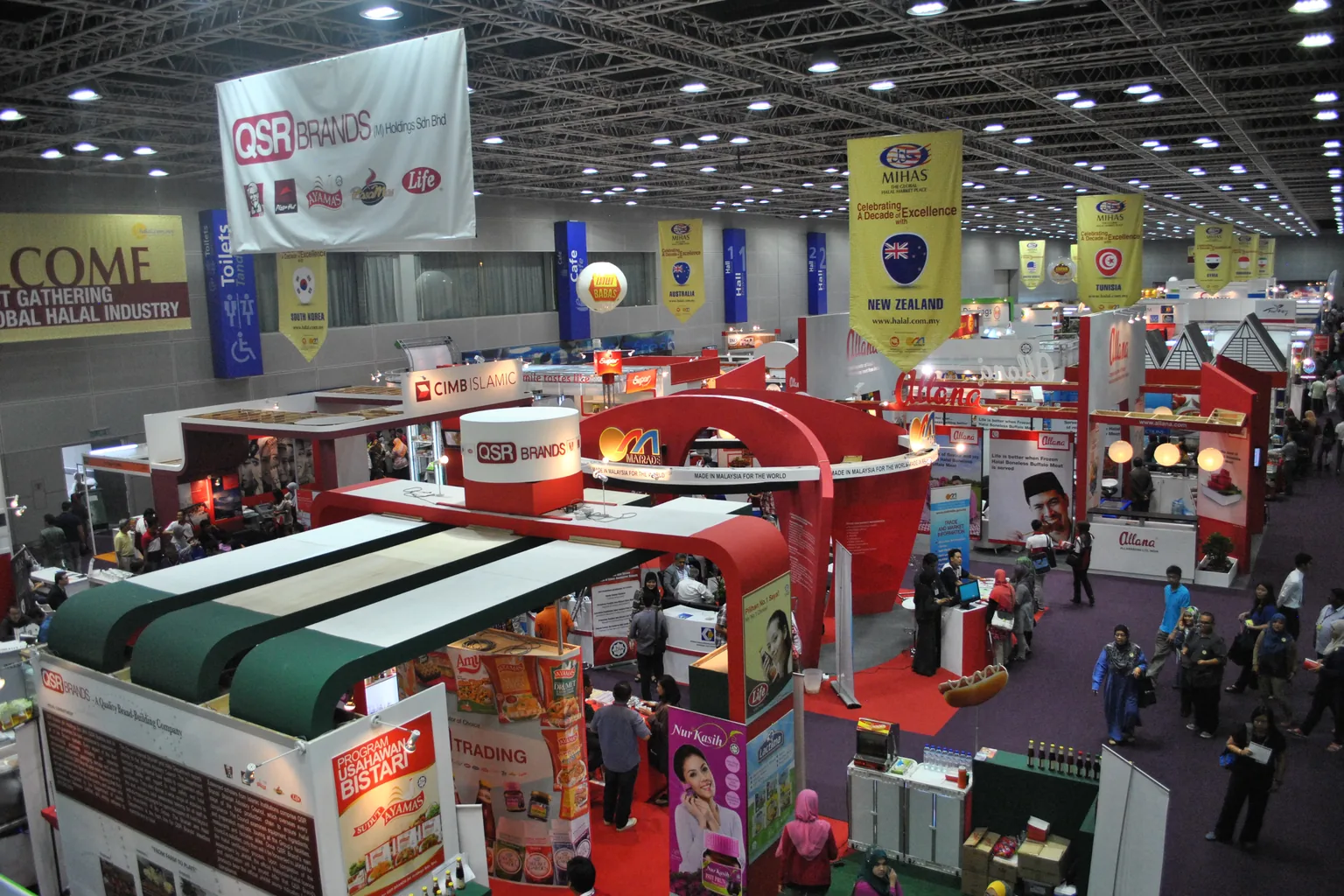
Imported halal food relies on foreign certifiers. JAKIM’s list effective 21 August 2026 recognises 96 foreign certification bodies in 49 countries or regions. Australia has seven, China and Japan six each, and Vietnam five. Uganda, Mongolia, Lithuania and Kenya have one each.19 In March 2025 the count was 85 bodies in 47 countries.26
Recognition is temporary. An appointment lasts three years, the body must report to JAKIM every year, and JAKIM audits it again when the term ends.19 JAKIM also audits documents and visits manufacturing premises, the minister said.26 It does drop bodies. From 19 February 2025 it withdrew three, in France, Croatia and China, including the China Islamic Association, with a grace period to 19 August 2025.27 In October 2023 it dropped the Halal Food Council of Europe in Belgium.28
On 5 March 2025 the Dewan Rakyat was told that AI and blockchain were being considered for real-time monitoring of foreign certifiers.29 “AI allows for automatic analysis of compliance data, identifying certification inconsistencies and issuing early warnings of non-compliance,” Na’im said.29 He added that JAKIM might work with foreign bodies on such systems. MY IHAB, an online system for recognition applications, was then in the final stages of development, he said.26 That was a statement of intent, not a launched pilot.
JAKIM’s systems: launched and promised
Some of JAKIM’s digital tools are live. SmartHalal, an app launched in January 2021 with the Malaysian Communications and Multimedia Commission and state religious departments, scans QR codes and maps certified suppliers.30 Since 5 May 2025 every application has been processed electronically, and successful applicants receive e-certificates through MYeHALAL; printed copies are charged as reprints.31 JAKIM’s portal offers a public “Verify Halal Status” search across ten categories, including consumer goods and slaughterhouses.32
From 15 August 2025 JAKIM began running MyHALALINGREDIENTS, a system that collects data on raw materials. It is integrated with MYeHALAL, MITI told Parliament.33 HDC runs a separate HDC Halal Integrated Platform for small firms and exporters.6
The AI layer is still a promise. MyeHALAL 2.0 was announced in Parliament in October 2023, built with the Prime Minister’s Department and MAMPU, the civil-service modernisation unit. Blockchain was a long-term aim, and the goal was to process applications within 23 days. The chairman of the Malaysia Halal Council had earlier said approval decisions must be made within 30 working days.34 On 22 May 2026 Sirajuddin said on Bernama TV that the system, with AI, would be introduced within the next few months, Bernama reported.7 “Through MyeHALAL 2.0, the system will review every submitted application based on our database, namely MyHALALINGREDIENTS, which functions as a support system,” he said.7
He also described a fast lane already in use. “For companies that are highly committed and have never faced any issues, we classify them under the whitelist. This means that if they apply and promptly submit supporting documents, halal certification approval can be completed within a week,” he said.7 We found no report by 17 November 2026 that the AI review had launched. Nor did we find published data on JAKIM’s processing times or rejection rates to judge it against.
Indonesia shows what such a system does in practice. Its AI makes preliminary checks of document completeness, matches ingredient information against references and flags inconsistencies.35 That helps with missing papers and mismatched ingredient names. It cannot see a stunner’s dial.
Trade promotion has gone further. At MIHAS 2026, the Malaysia International Halal Showcase, MATRADE says its “agentic AI” platform generated more than 22,000 business appointments. Of these, 324 matches reported RM28 million in sales.23 The show’s total was RM6.78 billion, up 12% from RM6.05 billion in 2025.23
MATRADE’s figures; shares are our arithmetic. The AI platform runs until 2027, so more sales may follow.
Source: MATRADE release via Malay Mail (29 September 2026).
Show the numbers
| Share | What |
|---|---|
| 1.5% | of more than 22,000 AI-assisted appointments reported sales (324 matches) |
| 0.4% | of the show’s RM6.78 billion in reported sales came from those matches (RM28 million) |
What a laboratory can prove
Paperwork describes a process; a lab tests a sample. Two methods dominate. PCR, the polymerase chain reaction, copies tiny fragments of pig DNA until they can be detected. ELISA detects pig proteins with antibodies. Both struggle with heavily processed products.
A 2025 study by researchers at IIUM’s halal institute, a Malaysian lab and Indonesia’s IPB University tested nine collagen products. Real-time PCR found pig DNA in three, two of them labelled as fish or marine collagen, though the authors say those two results were not confirmed. ELISA found pig protein in two.36 Of three products labelled as pig collagen, each test used alone missed two, a false-negative rate of 66.7%. The authors blame “DNA degradation, protein denaturation, and matrix interference”.36 The kit maker reports PCR sensitivity of 0.001% and ELISA sensitivity of 0.5%.36 Malaysia has its own test method, MS 2627:2017. It treats a cycle-threshold value of 32 to 40 as positive for pig DNA; a lower value means more DNA.36 Indonesia’s halal agency recommends a national real-time PCR standard, SNI 9278:2024.37
Results can also be wrong the other way. In May 2014 the Health Ministry reported pig DNA in two of three batches of Cadbury chocolate samples, Dairy Milk Hazelnut and Dairy Milk Roast Almond. Cadbury recalled them and JAKIM suspended their certification.38 More than 20 Malay-Muslim groups called for a boycott. On 2 June JAKIM said 11 samples sent straight from the factory to an accredited lab showed no pig DNA. The minister then in charge of religious affairs said the ministry’s samples had not come directly from the factory and could have been contaminated.39
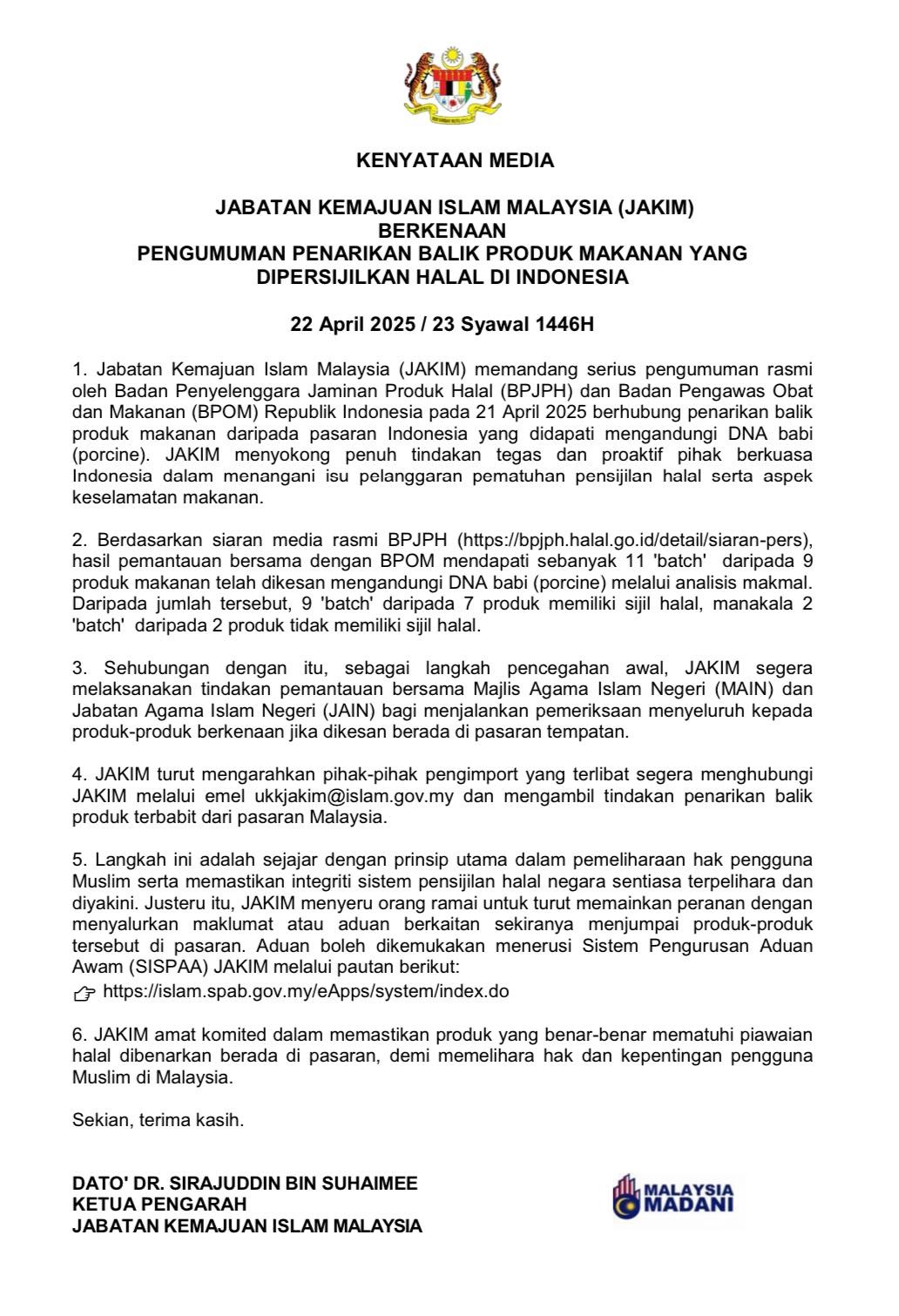
Indonesia showed both sides in April 2025. Its halal agency, BPJPH, and its food and drug agency, BPOM, reported pig DNA in 11 batches of nine products. Nine batches of seven products had halal certificates.40 Most were jellies and marshmallows, six from China and two from the Philippines, plus one Indonesian gelatin.41 The next day JAKIM ordered checks with state religious bodies and told importers to recall the products in Malaysia.40 LPPOM, the Indonesian auditor that had examined seven of the nine products, then tested other batches of four of them by real-time PCR and found no pig DNA. Results differed between batches of the same product, it said.37
Noses, cameras and label readers
Researchers want faster tools because lab methods, in one paper’s words, “are time-consuming, expensive, and require complex laboratory procedures to be performed by skilled personnel”.42 Electronic noses use gas sensors to read the smell of a sample. One team at Beijing University of Chemical Technology combined a neural network and a random forest model to estimate how much pork had been mixed into beef. The model scored an R² of 0.9977 on a test set of 63 samples.42 An earlier e-nose identified pork in beef with 98.10% accuracy, the paper notes.42 Studies have used e-noses to detect lard in palm olein since 2005. A 2011 study used one on lard mixed with chicken fat, with a 15-second measurement after 10 minutes of heating the sample.43 All of these were laboratory tests.
Cameras have been tried on a Malaysian line. HalalNet, part of a project called SYCUT, classified images of chicken neck cuts at a slaughter site in Semenyih that processes 3,000 birds an hour. Its dataset held 737 halal images and only 30 non-halal ones. Deliberately slaughtering non-halal birds on the conveyor “was costly and hard to obtain”, so those were photographed away from the line, against a different background.44 The authors segmented images so the network would focus on the cut, not the background. Test accuracy was 96.5% on 256 image pairs.44 With only 30 non-halal images, that figure says little about a working line.
Label-scanning apps fail earlier. A typical halal scanner photographs the label, reads the text, splits it into ingredients, looks each one up in a halal and haram database, and classifies the product.45 Gelatin, carmine and ethanol-based flavourings can appear under unfamiliar names or codes such as E120 and E441, the authors note. HalalBench, a 2026 preprint whose authors validated it on a scanner app called HalalLens, tested four text-recognition engines on 1,043 images in 14 languages. The best scored an F1 of 0.193, a score that balances correct and missed matches, “leaving over 80% of ingredient annotations unmatched”. All scored zero on Japanese.45 One misread word can hide an ingredient: “A misrecognized ‘Gelaton’ causes silent lookup failure, omitting a potentially haram substance from analysis.”45 Haram means forbidden. The benchmark has not been peer reviewed.
| Product | Used by authorities | Copes with processed products | Quick and cheap | Best reported result | Verdict |
|---|---|---|---|---|---|
| Real-time PCRDetects pig DNA | YesIndonesia’s SNI 9278:2024 | Partlymissed 2 of 3 pig-collagen samples | Noskilled lab | Kit sensitivity 0.001% (kit maker) | ✓Reference test, with limits |
| ELISADetects pig protein | Unknown | Partlymissed 2 of 3 | Nolab kit | Kit sensitivity 0.5% (kit maker) | !Catches some of what PCR misses |
| Electronic nose with AIReads smell profiles | Nolab studies | Unknown | Yes15-second reading | R² 0.9977, pork in beef | ?Lab results only |
| Camera AI on a lineChecks chicken neck cuts | Noone research site | Not applicable | Unknown | 96.5% test accuracy | ?Only 30 non-halal images |
| Label-scanning appsRead ingredient lists | Noconsumer apps | Not applicable | Yesfree apps | F1 0.193, best engine | ✕Misses most ingredients |
Our reading of the studies. Numbers are lab or benchmark results, not field performance; kit figures come from the kit maker.
Source: Halalsphere (31 July 2025); LPPOM MUI (29 April 2025); Foods (20 February 2022); Roy and Yadav (2021); IJIE (2019); HalalBench (2026).
Show the numbers
| Product | Used by authorities | Copes with processed products | Quick and cheap | Best reported result | Verdict |
|---|---|---|---|---|---|
| Real-time PCR | Yes (Indonesia’s SNI 9278:2024) | Partly (missed 2 of 3 pig-collagen samples) | No (skilled lab) | Kit sensitivity 0.001% (kit maker) | Reference test, with limits |
| ELISA | Unknown | Partly (missed 2 of 3) | No (lab kit) | Kit sensitivity 0.5% (kit maker) | Catches some of what PCR misses |
| Electronic nose with AI | No (lab studies) | Unknown | Yes (15-second reading) | R² 0.9977, pork in beef | Lab results only |
| Camera AI on a line | No (one research site) | Not applicable | Unknown | 96.5% test accuracy | Only 30 non-halal images |
| Label-scanning apps | No (consumer apps) | Not applicable | Yes (free apps) | F1 0.193, best engine | Misses most ingredients |
Blockchain, a shared ledger that is hard to alter, is often proposed for traceability. A 2024 systematic review says its features “should, on paper, facilitate the tracking and verification of halal products from their origin to the end consumer”.46 A September 2026 review led from Universiti Putra Malaysia found processors’ “awareness and knowledge of blockchain remain relatively limited”. Cost, infrastructure and technical skills were the commonest barriers.47 A ledger also records only what someone types in.
Fake logos move online
On 16 November 2026 KPDN’s Penang office seized 27,000 bottles of hair dye worth RM1.08 million at a warehouse in Tasek Gelugor. Officers suspect the products carried the Malaysian halal logo without a valid certificate. They were imported from China and marketed through TikTok, Shopee and Lazada.48 KPDN estimates about 600,000 bottles were sold in six months at RM40 each, roughly RM24 million by our arithmetic.
Penang KPDN director S. Jegan described the method. The company engaged popular social media influencers and affiliate agents, he said. KPDN’s inspection found that the halal certificate in its promotional materials belonged to another company, he added.48 The case is under investigation under Section 16 of the Trade Descriptions Act 2011, and nobody had been charged in the reports we found. He advised buyers to check JAKIM’s website, not sellers’ claims or affiliate promotions.48 A borrowed certificate is exactly what a register lookup catches.
The best-known case came to light in Senai, Johor, in December 2020. On 8 December the domestic trade minister told Parliament the preliminary investigation had found no pork at the scene. Officers inspected 128 premises from 4 to 6 December and took no further action outside the original case.18 In February 2023 a Senai frozen-food company pleaded guilty to seven charges, including using a fake halal logo, and was fined RM1.5 million. A director was fined RM100,000.49 The charges concerned 3,418 boxes of frozen food with false trade descriptions, used without the approval of two Australian suppliers, and halal logos used without the approval of Australian certification bodies.49
Early press coverage alleged more than the charges that followed, and we found no court finding on those wider claims. The case that reached judgment was about labels.49
Cosmetics and medicines
Cosmetics and medicines have their own schemes. A cosmetic must be notified to the National Pharmaceutical Regulatory Agency (NPRA), or cleared by it for export only, before it can be certified halal.8 The State of the Global Islamic Economy report ranks Malaysia first for halal pharmaceuticals and cosmetics.24 The pharmaceutical scheme covers prescription and over-the-counter medicines, supplements and traditional remedies, and follows MS 2424:2019.8 A 2026 review from IIUM found three main problems in applying it: “raw material traceability, cross-contamination during manufacturing, and limited halal knowledge and competency among industry stakeholders”.50 Collagen, used across food, cosmetics and medicines, is also where lab tests struggle most, as the 2025 study showed.36
Who decides what is halal
JAKIM’s manual defines halal as what is permitted in Islam “berdasarkan Hukum Syarak dan fatwa”: based on Islamic law and formal rulings.8 That is why every certificate passes a panel with a Shariah expert. In March 2025 Na’im said JAKIM would look at AI here too. “The efforts to use AI in determining the hukum (Islamic law) will also be considered by Jakim,” he told Parliament.29 JAKIM would ensure that data and decisions made with AI were in line with Islamic principles, he said.26
Malaysian scholars urge caution. A January 2026 paper by authors from UiTM, Universiti Malaya and the Federal Territories Mufti’s Office concludes that AI can support, but not replace, muftis and fatwa committees. It cites AI’s “limitations in contextual reasoning (waqi‘), moral judgement, and ijtihad”, meaning independent legal reasoning.51
Some scholars already use AI to explain their views. In May 2025 Datuk Seri Dr Zulkifli Mohamad Al-Bakri, a former Federal Territories mufti, introduced two AI “Pegawai Pintar Syariah”, or smart Shariah officers, named AI Dr Munir and AI Dr Munirah. Built with ChatGPT Plus and Hedra Studio, they draw on more than 9,000 questions in the Al-Inarah app, and their answers rest on his own positions, he said.52
Indonesia draws the line plainly. Its certification platform, SiHalal, uses AI and machine learning to check documents, said Nurhanudin, head of data and information technology at BPJPH.35 New foods raise new questions too. Singapore’s Islamic Religious Council, MUIS, has issued a fatwa on alternative proteins such as cultivated meat and plant-based products.53 Questions like these go to scholars.
Authority over halal determination remains with verifiers, facilitators, auditors, and the Fatwa Committee.
Indonesia, Singapore and the Gulf
Indonesia went the other way from Malaysia and made certification compulsory. BPJPH, under its religious affairs ministry, took over from LPPOM MUI, the Indonesian Ulema Council’s assessment body, on 17 October 2019.54 Under Law 33/2014 and a 2024 regulation, the first phase covered food and beverages from medium and large firms in late 2024. Breaches can bring warnings, fines, revoked certificates or recalls.55
The next phase slipped. On 17 October 2026, a day before micro and small firms and imports were due to comply, the government moved their deadline to October 2028.56 The free certification programme, SEHATI, had set a 2026 target of 1.35 million certificates for small businesses and missed it.57 In 2025 BPJPH said 115,450 Halal Product Process Assistants were on hand to guide small firms through it.41 “The target was missed, and many MSMEs felt the timing was wrong. The process remained burdensome, and they lacked the capacity to prepare the required documents, so the deadline was extended to 2028,” said MSME Minister Maman Abdurrahman on 25 October.57 “I would like to highlight that halal policy is an issue raised by most embassies,” said Airlangga Hartarto, the coordinating minister for economic affairs, on 13 November.58
- 1Law 33/2014October 2019BPJPH, under the religious affairs ministry, takes over certification from LPPOM MUI.
- 2Regulation 42/2024Late 2024Certification becomes compulsory for food and beverages from medium and large firms.
- 3Deadline moved18 October 2026The original date for micro and small firms and imports. A target of 1.35 million free certificates was missed.
- 4Regulation 40/2026October 2028New dates for small firms, imported food and beverages, cosmetics, supplements and chemicals.
- 5Unchanged2029 and 2034Over-the-counter medicines by 17 October 2029; prescription medicines by 17 October 2034.
As of September 2026 Indonesia had signed mutual recognition agreements with 116 of the 199 foreign halal institutions that applied.
Source: JAKIM (13 October 2022); Antara (10 June, 18 September, 17 October, 26 October and 13 November 2026).
Show the numbers
| Step | Who | What | Detail |
|---|---|---|---|
| 1 | Law 33/2014 | October 2019 | BPJPH, under the religious affairs ministry, takes over certification from LPPOM MUI. |
| 2 | Regulation 42/2024 | Late 2024 | Certification becomes compulsory for food and beverages from medium and large firms. |
| 3 | Deadline moved | 18 October 2026 | The original date for micro and small firms and imports. A target of 1.35 million free certificates was missed. |
| 4 | Regulation 40/2026 | October 2028 | New dates for small firms, imported food and beverages, cosmetics, supplements and chemicals. |
| 5 | Unchanged | 2029 and 2034 | Over-the-counter medicines by 17 October 2029; prescription medicines by 17 October 2034. |
Imports depend on mutual recognition. By September 2026 Indonesia had signed agreements with 116 of 199 foreign halal institutions that applied, 58% by our arithmetic. “Halal certification is not an import restriction. This means imported goods are still allowed to enter, but once they are distributed in the market, they must be certified,” said Trade Minister Budi Santoso on 17 September.59 On 25 September Zahid announced a Malaysia-Indonesia Halal Council, chaired by BPJPH, with Malaysia as secretary-general. Its first meeting was scheduled for October 2026.60 We found no report that it took place.
Singapore chose verification. From 1 October 2025 MUIS’s new digital certificates for certified businesses carry a QR code. Anyone can scan it at a shop “to instantly check if their halal certification is real and still valid”.61 MUIS recognises 101 foreign bodies and now assesses them by risk, and new law lets them appeal its decisions.61
The Gulf works through import paperwork. Saudi Arabia’s Food and Drug Authority requires a halal certificate for foods that need one or carry a halal label, from centres designated by the Saudi Halal Center. Meat, poultry and raw gelatine need a halal slaughter certificate.62 Since November 2023 more common foods have needed halal and shipment certificates, says SGS, a certifier the centre recognises.63 In the UAE, Cabinet Decree No. 10 of 2014 requires halal certificates for final products and their raw materials from ministry-registered bodies. A Halal National Mark is optional.64
| Country | The rule | Foreign certifiers | Digital checks and AI |
|---|---|---|---|
| Malaysia | Voluntary since 1974; false halal claims are offences | 96 recognised in 49 countries | e-certificates, portal search; AI review announced, launch not found |
| Indonesia | Compulsory; small firms and imports by October 2028 | Mutual recognition with 116 of 199 applicants | SiHalal uses AI to check documents |
| Singapore | MUIS certifies | 101 recognised, assessed by risk | QR code on digital certificates |
| Saudi Arabia | Certificates required for listed foods and halal-labelled imports | Centres designated by the Saudi Halal Center | None found in our sources |
| UAE | Certificates required for products and raw materials | Bodies registered by the ministry | Optional Halal National Mark |
Source: JAKIM; Antara; GovInsider; MUIS; SFDA; UAE Ministry of Industry and Advanced Technology.19355659616264
Things you probably didn’t know
- Life is judged by blood or movement. JAKIM’s manual says an animal is recognised as still alive at slaughter when blood spurts or it moves.8
- Non-Muslim restaurateurs often apply. Halal certificates are usually applied for by non-Muslim restaurant operators, the Deputy Prime Minister said in 2024.17
- “No pork, no alcohol” is not a certificate. Such premises are not necessarily halal, the religious affairs minister said.16
- Imports must name their certifier. Imported halal goods must carry the name of the JAKIM-recognised foreign body that certified them.19
- Halal fees add up. JAKIM and state bodies collected RM80,032,254.43 in certification fees over 2012–2023.15
- Consultants are kept out. Certifiers must deal with applicants directly, not through middlemen such as consultants.8
- MIHAS began at 500 booths. The halal showcase started in 2004 and had 2,100 booths at its most recent edition, MITI said in May 2025.21
- Fish collagen tested positive. In the 2025 study, PCR flagged pig DNA in two products labelled as fish or marine collagen; the authors say this was not confirmed.36
What worked and what didn’t
The checks that worked tested something real: a batch on the shelf, a sample from the factory, a certifier’s record.
Too early
A certificate anyone can scan
Since 1 October 2025 MUIS’s new digital certificates in Singapore carry a QR code that shows whether a certificate is real and still valid.61 A trick like displaying someone else’s certificate should fail at a scan. In Penang, KPDN says a seller did exactly that.48
Lesson: it moves verification to the customer at the point of sale; we found no published results yet.
Too early
Rewarding a clean record
Malaysian applications went fully electronic on 5 May 2025.31 Clean-record firms can be approved within a week, and since 1 April 2026 can hold five-year certificates.711 No processing-time data has been published to confirm the gains.
Lesson: trusted firms need less attention, which can free auditors for risky ones, if processing data shows it.
Worked
Testing what is on the shelf
In April 2025 Indonesian regulators tested products already on sale and found pig DNA in certified sweets. JAKIM ordered checks and recalls in Malaysia the next day.40
Why it worked: a certificate audits a process once; market sampling tests the product people buy.
Didn’t work
Warnings without escalation
By police accounts, the Puchong plant kept operating after three or four raids and inspections and several JAKIM notices.23 Licensing and halal slaughter sit with different bodies in Selangor.5 The investigation is continuing.
Lesson: repeated notices need a deadline and a consequence, and one agency must own the plant.
Didn’t work
Labels taken at face value
In 2023 a Senai company pleaded guilty to charges over false trade descriptions and halal logos on 3,418 boxes, and was fined RM1.5 million.49 Officials found no pork at the scene.18
Lesson: a printed logo proves nothing; the certifier’s register does.
Didn’t work
Certified products, positive tests
Seven of the nine products Indonesia flagged in 2025 held halal certificates.40 The auditor found other batches clean, so the certificate described the process, not the batch.37
Lesson: certification needs post-market sampling behind it.
Didn’t work
A deadline set before capacity
Indonesia missed its target of 1.35 million free certificates for small firms and moved the October 2026 deadline to 2028.57 Only 116 of 199 foreign applicants had mutual recognition by September.59
Lesson: a compulsory rule needs auditors, paperwork help and foreign agreements in place first.
What to do now
None of this is religious, legal or investment advice. For a specific ruling, ask JAKIM or your state religious authority.
For shoppers
- Check a product or premises on JAKIM’s “Verify Halal Status” search or the SmartHalal app, not a seller’s screenshot or an influencer’s post.303248
- On imported goods, look for the named foreign certifier. “No pork, no alcohol” is not a certificate.1619
For restaurants and caterers
- Keep each chicken supplier’s slaughterhouse name and certificate on file now, ahead of KPDN’s proposed disclosure rule.4 After Puchong, MAIS urged operators to check their supply.9
- Certification costs RM100 a year per restaurant premises, or RM100 to RM700 for caterers depending on turnover, and is voluntary.816
For manufacturers and exporters
- Keep ingredient data cleanMyHALALINGREDIENTS feeds the review JAKIM plans to automate.733
- Build a recordA clean record can earn one-week approval and, after five years, a five-year certificate.711
- Test collagen and gelatin earlyThey need animal-DNA analysis, and one test alone can miss pig material.1336
- Check Indonesia’s listConfirm your certifier has mutual recognition with BPJPH before October 2028.5659
For online platforms
- Match certificate numbers against JAKIM’s register before a listing says halal. A borrowed certificate is the pattern KPDN alleges in Penang.48
For anyone building halal AI
Questions to ask before launch
What to watch to 2030
- Any month now: MyeHALAL 2.0. Watch for a launch date, processing times and whether officers review every AI flag.7
- Pending: the Puchong investigation. Investigators are working under the Trade Descriptions (Definition of Halal) Order 2011.2
- Proposed 12 November 2026: chicken disclosure. KPDN’s rule would show shoppers where a chicken was slaughtered and who certified it.4
- Proposed 17 November 2026: Selangor’s slaughterer rule. The state is drafting a requirement for a certified halal slaughterer at every licensed slaughterhouse.5
- 2027: MIHAS’s AI platform. MATRADE says it runs until 2027, which will show whether its RM28 million grows.23
- 17 and 18 October 2028: Indonesia’s main deadline. Small firms, imported food and cosmetics must comply. Over-the-counter medicines follow in 2029 and prescription drugs in 2034.56
- 2030: HIMP targets. RM70 billion of exports, RM231.1 billion in sector value, 10.8% of GDP and RM25 billion invested in halal parks.22
Halal rulings belong to the religious authorities named here; we report their positions and make no ruling of our own. The Puchong and Penang cases are open investigations described from official statements, and nothing here states that anyone has broken the law. Company and trade-show figures are their own claims, and calculations marked as ours are illustrative. Conversions use Bank Negara Malaysia’s middle rate of 17 November 2026: RM4.089 per US dollar.
Sources
- Bernama, Puchong chicken seizure, 30 October 2026: bernama.com
- Bernama, Puchong stunning voltage, 1 November 2026: bernama.com
- Bernama, Puchong warehouse’s history, 31 October 2026: bernama.com
- The Star, chicken retailers may disclose slaughterhouses, 12 November 2026: thestar.com.my
- Bernama, Selangor slaughterhouse rules, 17 November 2026: bernama.com
- Bernama, halal exports in 2025, 16 April 2026: bernama.com
- Bernama, AI in MyeHALAL 2.0, 22 May 2026: bernama.com
- JAKIM, Manual Prosedur Pensijilan Halal Malaysia (Domestik) 2020, in force 1 January 2021: halal.gov.my
- Malay Mail (Bernama), Puchong supplier shut, 31 October 2026: malaymail.com
- Bernama, KPDN rules on chicken’s halal status, 12 November 2026: bernama.com
- JAKIM, Pekeliling Pensijilan Halal Malaysia Bil. 1/2026, 12 February 2026: halal.gov.my
- JAKIM, certification page, accessed 17 November 2026: halal.gov.my
- JAKIM, DNA analysis of collagen and gelatin, 6 May 2021: halal.gov.my
- JAKIM, ISO/IEC 17065 accreditation, March 2021: halal.gov.my
- Malay Mail (Bernama), halal certification fees, 29 October 2024: malaymail.com
- Malay Mail (Bernama), halal certification stays voluntary, 13 November 2024: malaymail.com
- Malay Mail (Bernama), Zahid on halal certificates, 16 September 2024: malaymail.com
- Malay Mail (Bernama), meat cartel investigation, 8 December 2020: malaymail.com
- JAKIM, recognised foreign certification bodies, 21 August 2026: halal.gov.my
- Malay Mail (Bernama), HIMP 2030 launch, 23 March 2023: malaymail.com
- The Star (Bernama), halal exports in 2024, 1 May 2025: thestar.com.my
- The Vibes, halal industry and GDP, 12 December 2025: thevibes.com
- MATRADE via Malay Mail, MIHAS 2026 results, 29 September 2026: malaymail.com
- The Star (Bernama), Global Islamic Economy ranking, 4 June 2026: thestar.com.my
- Bank Negara Malaysia, exchange rates, 17 November 2026: bnm.gov.my
- The Star (Bernama), foreign certifier review, 5 March 2025: thestar.com.my
- JAKIM, three foreign certifiers withdrawn, 13 March 2025: halal.gov.my
- JAKIM, Belgian certifier withdrawn, 20 October 2023: halal.gov.my
- The Star, JAKIM explores AI and blockchain, 5 March 2025: thestar.com.my
- Malay Mail (Bernama), SmartHalal app, 29 January 2021: malaymail.com
- The Star (Bernama), certification goes digital, 8 May 2025: thestar.com.my
- JAKIM, Halal Malaysia Portal, accessed 17 November 2026: halal.gov.my
- The Sun (Bernama), HIMP 2030 and halal ingredients, June 2026: thesun.my
- New Straits Times, MYeHALAL 2.0, 12 October 2023: nst.com.my
- GovInsider, SiHalal and AI, June 2026: govinsider.asia
- Basuki, Zainal and Abdullah Sani, PCR and ELISA for porcine detection, Halalsphere 5(2), 31 July 2025: journals.iium.edu.my
- LPPOM MUI, on the porcine DNA findings, 29 April 2025: halalmui.org
- Malay Mail, Cadbury recall, 24 May 2014: malaymail.com
- Malay Mail, Cadbury retest, 2 June 2014: malaymail.com
- JAKIM, media statement on Indonesian recall, 22 April 2025: halal.gov.my
- FoodNavigator-Asia, pork in Indonesian sweets, 6 May 2025: foodnavigator-asia.com
- Huang et al., e-nose for adulterated meat, Foods 11(4):602, 20 February 2022: ncbi.nlm.nih.gov
- Roy and Yadav, e-noses for food adulteration, Journal of Food Science and Technology, 11 March 2021: ncbi.nlm.nih.gov
- Elfakharany et al., HalalNet, International Journal of Integrated Engineering 11(4), 5 September 2019: journal.uthm.edu.my
- HalalBench, OCR benchmark preprint, arXiv 2604.22754, 2026: arxiv.org
- Ziegler, Uli and Tatari, blockchain in halal supply chains, Journal of Halal Quality and Certification 2(1), 2024: hrcak.srce.hr
- Razale, Kamarulzaman and Lim, blockchain in halal meat, IJEMP 9(35), 30 September 2026: gaexcellence.com
- The Star (Bernama), hair dye seized in Penang, 16 November 2026: thestar.com.my
- Utusan Malaysia, meat cartel fine, 22 February 2023: utusan.com.my
- Mohd Latiff et al., MS 2424:2019 review, Halalsphere 6(2), 31 July 2026: journals.iium.edu.my
- Meerangani et al., AI as a fatwa reference tool, Journal of Fatwa Management and Research 31(1), 30 January 2026: jfatwa.usim.edu.my
- Sinar Harian, AI Shariah officers, 30 May 2025: sinarharian.com.my
- MUIS, chief executive’s seminar remarks, 24 September 2025: muis.gov.sg
- JAKIM, Indonesia’s halal authority, 13 October 2022: halal.gov.my
- Antara, firms urged to apply, 10 June 2026: antaranews.com
- Antara, mandate extended to 2028, 17 October 2026: antaranews.com
- Antara, MSME deadline extended, 26 October 2026: antaranews.com
- Antara, Regulation 40/2026, 13 November 2026: antaranews.com
- Antara, imports and the halal mandate, 18 September 2026: antaranews.com
- Antara, Malaysia-Indonesia Halal Council, 26 September 2026: antaranews.com
- MUIS, digital halal certificates, 24 September 2025: muis.gov.sg
- SFDA, food clearance requirements, April 2025: sfda.gov.sa
- SGS, Saudi halal categories, 22 January 2024: sgs.com
- UAE MoIAT, halal programme, accessed 17 November 2026: moiat.gov.ae
Related research
 Before you buy a robot waiter, read your receiptsA serving robot rents for RM1,500–3,000 a month in Malaysia, about what a minimum-wage worker costs.
 Plus 16%, minus 4.5%: the AI that sells online, and the AI that doesn’tIn randomised trials with millions of shoppers, a plain chatbot that answered questions before purchase lifted sales 16.3%.
 227 new cosmetics a day, four lab testsOf Malaysia’s active cosmetic notifications, 82,740 were first filed in 2025, about 227 a day.